What I said in August 2024
On 5 August 2024, as a sitting member of the Town Council, I raised concerns from the dais about how the 90 Virginian Lane competition was being run. Two days earlier a losing design team had written to elected officials that elements of its proposal had appeared in the winner’s plan, and its lead designer repeated the objection in public comment at that meeting. Addressing the letter from the dais, Councilmember Arne Jorgensen, now Mayor, said it was “uncomfortable, but it’s what this process, the process we set up almost 10 years ago now, and this is playing out.”
The records the Town of Jackson released in late 2025 show how the process ran from there. They include:
- voicemails in which the developer’s regional vice president tells the Housing Director, the official negotiating opposite her, “we’re going to get through this” and “I’m going to get our team involved tomorrow, and we’ll work with you to come up with a game plan,” and in a second call relays what another developer’s executive told her about a resident asking questions;
- a voicemail in which the same executive calls a sitting councilwoman directly to “touch base on your thinking” about the project;
- a county commissioner’s negotiating agenda, forwarded by the Housing Director to the developer and reviewed with its architect before his meeting;
- an email in which the Housing Director sends a reporter’s questions, with her answers drafted in, to the developer for review before replying;
- calendar records of private briefings for every elected official, with the developer invited and no minutes in the record;
- the Mayor’s own written account of at least three unrecorded meetings with the developer, and of a call to its architect to share his expectations for the design.
All of it is documented below, from the government’s own records and the Town’s official meeting video, so you can see it for yourself. You will be able to listen to the voicemail recordings, read the text messages, emails and letter as they were released, and watch the meeting where these concerns were raised.
Disclosure
I served on the Jackson Town Council through the period covered here and I am a candidate in the 3 November 2026 election. I am not a neutral party.
Open the full disclosure and how to read this page
- I served on the Jackson Town Council through the period covered here and I am a candidate in the 3 November 2026 election. I am not a neutral party.
- My votes: yes in November 2023 to release the competition; no in April 2024 on the zoning amendment that changed the rules after bids closed; no or abstaining on every other substantive 90 Virginian item after that, except the final one, where I voted yes in the mistaken belief that a formal action was needed to bring in outside review. The Department of Audit’s jurisdiction turns on the spending of public money, not on any vote.
- I raised these objections in public meetings while in office. The meetings are recorded and posted; the process did not change.
- In October 2025 I filed a 68‑page memorandum requesting procedural and statutory review, served on every Town and County elected official and both attorneys. That memorandum and the Town of Jackson’s records release are the basis of this page. Teton County released nothing comparable.
- Record means quoted from a public document. Transcript means my transcription of a recorded public meeting, with the date. Analysis means my conclusion. The button below hides all analysis.
Overview
Eleven companies competed to build housing on public land. Partway through, the rules changed, the government negotiated with two finalists at once, and what the project was supposed to deliver kept changing. A losing team then wrote to elected officials saying its own design and financing ideas had turned up in the winner's plan, and the elected officials were scheduled for private briefings, one or two at a time, with the developer invited and no minutes in the record.
Three years later the project was canceled. $28 million of land sits empty, the bonds run to 2030, and up to $500,000 of public money went to designs for a building that will not exist. No agreement was signed to fix how the design cost would be split with the developer, and nothing in the record shows the public holding the drawings it paid for. The accounting the records do not provide lists what the released records leave unanswered.
Eleven firms spent their own time and money on the understanding that every respondent would be treated on equal terms. Given the unequal treatment the records on this page show, any of them could bring a claim against the Town and County for that time and money, and so could the selected company after three years with no signed agreement. This page does not make that claim or assert that anyone has.
A request for proposals is a regulated way of awarding public business. Wyoming’s bidding statute, W.S. 15‑1‑113(a), names the request for proposal among the procurement methods it regulates and protects every “bidder or respondent” in it. The 90 Virginian Lane RFP published its own binding terms: a submission deadline of 2 February 2024, scoring criteria with point values, and selection on those criteria. Once released, those terms govern the government and every respondent equally until an agreement is signed or the solicitation is canceled and reissued.
An RFQ, a request for qualifications, asks companies to show they are capable, and the plan is worked out with the chosen partner afterward. This project was issued as an RFP and then run as an RFQ. How it should work explains the difference in full.
The RFP’s published terms were departed from in public decisions, and the private conduct around it broke no written rule because, on these points, there were no written rules. There was no rule about private contact during a competition, no process for a losing bidder to complain, no requirement to keep minutes of a meeting with a vendor, and no point at which anyone was obliged to stop and start over.
Those gaps can be closed with seven changes, listed at the end of the report card.
The full written review
Everything on this page, set out as a single document with the citations, the statutory analysis, and the exhibits attached in full — the text messages, the letter, the voicemail transcripts.
Where the $28 million came from
Most of it was SPET money. SPET is a local sales tax that voters approve for one specific named purpose. Two separate SPET votes paid for this land: the 2019 measure contributed $2.59 million directly, and the 2022 measure is repaying $18 million in bonds the Housing Authority took out to buy the parcel.
The rest was $5.5 million of County housing money and $2 million of Town housing money. The bonds run until 1 August 2030, so the repayment continues regardless of what happens on the site.
Before a second process begins
The Town and County are preparing a second solicitation for 90 Virginian Lane. Two rules come first: no private contact between a respondent and any official outside a noticed public meeting, and a standing public web page carrying every document as it is created.
Open the two rules
The Town and County are preparing a second solicitation for 90 Virginian Lane. Nothing on that should move until the rules on this page are adopted. Until an agreement is signed, a respondent is the other side of a negotiation, not a partner, and nothing is delegated to it. Two of the rules are not negotiable:
- No private contact. No meeting, call or message between a respondent and any elected official or staff member outside a noticed public meeting, from the day the solicitation is released to the day the agreement is signed. No developer in the room while officials are briefed, and no template, draft, press answer or staff work product sent to a respondent for review. No exceptions.
- Everything public, as it happens. A standing public web page for the project that carries the solicitation, every submission, the scoring, the staff reports, the correspondence and the instruments, posted as they are created. Nobody should have to file a records request or pay $500 to see how public land is being handled.
Whether or not any rule was broken here, the public does not want a project handled the way this one was. The standard for the next one is that all of it happens in the open. The full list is at the end of the report card.
State review, and the cost of these records
The Wyoming Department of Audit is reviewing this matter. The records release this page is built on cost $500 and is incomplete: the Town produced its records, and Teton County declined the same request as overly burdensome.
Open the details
The Wyoming Department of Audit is reviewing this matter. It has been collecting documents and planning interviews. I know this because I filed the request that prompted the review. The Department does not comment on work in progress, so what I can report is limited to my own side of it. As of today no local news outlet has reported the review.
Public records are not free. The records release this page is built on cost $500, and it is still incomplete. The Town Attorney produced the Town’s records. Teton County declined the same request as overly burdensome, so the County’s side of a project the two governments ran jointly is missing.
Information about how public land and public money are handled should not be this hard or this costly to obtain.
The voicemails
ListenThe Town released three voicemails, all left by Shannon Cox Baker, the developer’s regional vice president: two for the Housing Director, who was negotiating opposite her, and one for a sitting councilwoman. All three appear to have been left in the weeks when the legality of local housing projects was being questioned in public. In the call to the councilwoman she says she has been “following everything that’s happening in the news lately” and asks to “touch base on your thinking.”
You can listen to each recording below; the transcript and what it shows open underneath.
When these were recorded
The Town released these recordings without dates. The file timestamps show when the Town exported the files, not when the messages were left. The government holds the actual timestamps.
What the record does fix is a window. These were produced against a search period closing 29 October 2025, so they fall on or before that date. The call relaying what a critic is doing describes a resident’s scrutiny of the project in the present tense, and that resident convened a public town hall on housing finance at the Teton County Library on 23 October 2025 which the Mayor and councilmembers attended. The call to the councilwoman opens with Cox Baker saying she has “been kind of following everything that’s happening in the news lately.” All three calls appear to fall in or near the last week of October 2025, when the legality of local housing projects was being questioned in public.
The developer offers its team to the Housing Director
She tells the Housing Director “we’re going to get through this” and offers to get the Pennrose team involved to work out a game plan with her.
Transcript and context
Why this is here. The developer offers to put its own staff to work helping the public employee who is supposed to be negotiating opposite it. In the 30 September email chain the same person reviewed the Town's answers to a reporter before they were sent.
The developer relays what a critic is doing
She relays to the Housing Director what an executive at another housing developer told her about a resident asking questions, and hopes the Housing Director has “protection.”
Transcript and context
Why this is here. The developer is passing political intelligence to the public official it is negotiating against, about a member of the public asking questions, and describing scrutiny of the project as a scandal “of her making.” The developer and the public employee are talking as though they are on the same side of a problem.
And note where the intelligence came from. Christian Pritchett is listed as Chief Development Officer of BlueLine Development — a different company, on a different publicly supported housing project in this valley, and one of the private partners named in the staff report’s own comparison table. So on this recording, an executive at one housing developer has briefed an executive at another about a resident asking questions, and that executive is relaying it to the government official negotiating opposite her. Two developers and a public employee, comparing notes on a member of the public.
The developer calls a sitting councilwoman
Referring to what she has been following in the news, she asks a sitting councilwoman to “touch base on your thinking” about 90 Virginian, offers her own views, and gives her cell number, the same number that appears in the text messages.
Transcript and context
This call is also what identifies the text messages. She gives her own number aloud, and it is the number that received a county commissioner’s negotiating agenda in the text messages, and the number that replied “Just reviewed this with Andy at United gate.” The identification comes from the speaker herself, inside the government’s own release.
Why this is here. The developer is calling an elected official directly, with no staff involved, to ask what she is thinking about a project she will vote on, and offering to share its own views. She did not take the meeting. With a no-contact rule in place this call could not have been made at all.
The text messages
ReadIn April 2025 a sitting Teton County Commissioner wrote out what he intended to get from the developer at a private meeting that afternoon. The Housing Director forwarded his message to the developer’s regional vice president, who reviewed it with the project architect at an airport gate before the commissioner’s meeting took place. A second thread, between the Housing Director and the same developer executive, holds one message from a twenty-five-month search period.
The screenshots are shown as released. Each item opens to the full record.
16 April 2025 · A commissioner’s terms, delivered to the developer
Commissioner Len Carlman’s agenda for his meeting with Pennrose is forwarded by the Housing Director to Shannon Cox Baker, who replies “Just reviewed this with Andy at United gate.” Andy Rockmore is the project architect.
Open the screenshots and the sequence
A commissioner's negotiating terms, delivered to the developer before his meeting
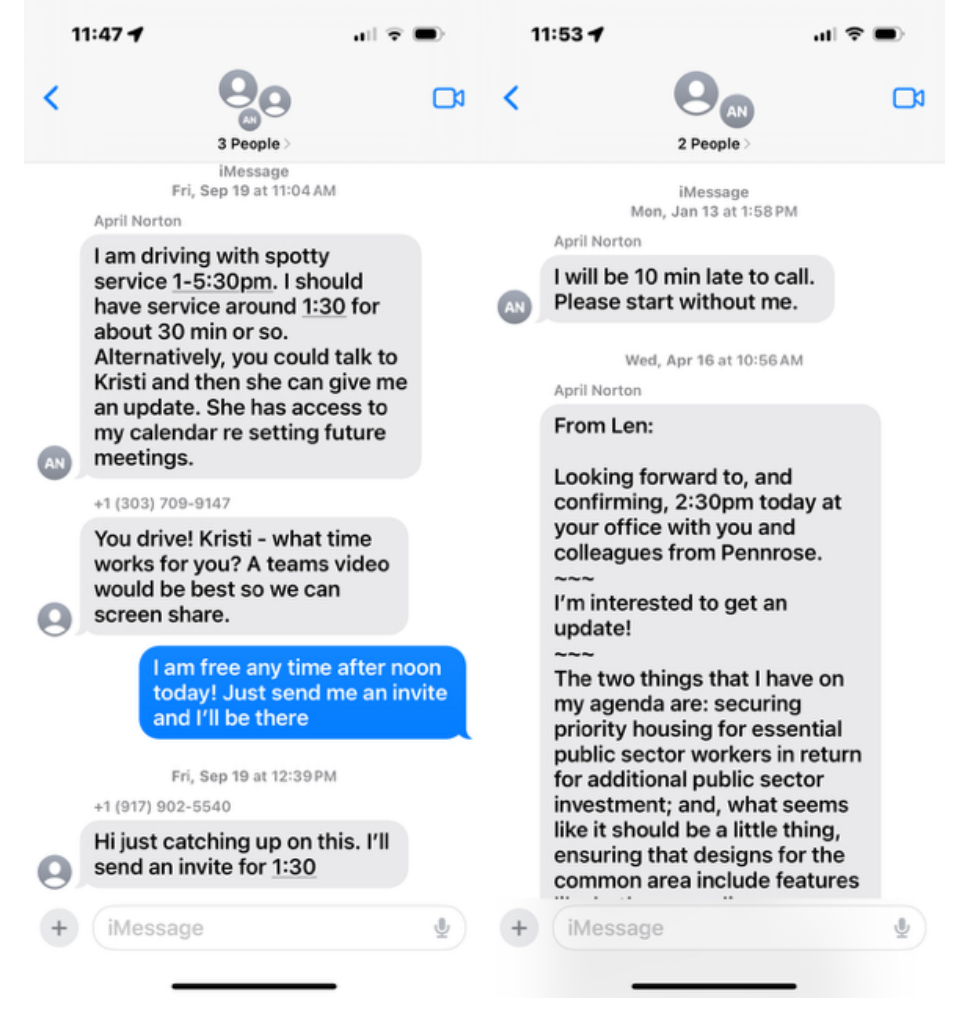
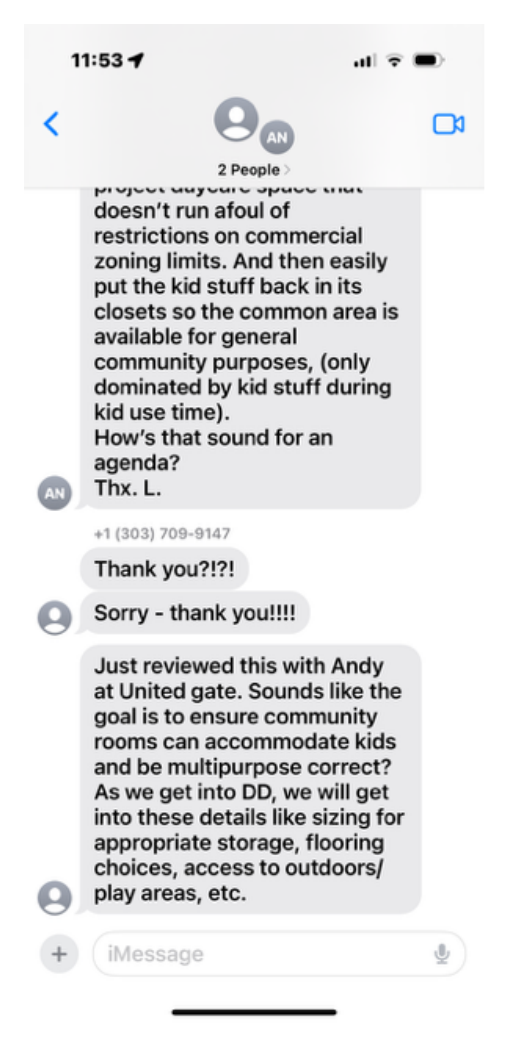
The sequence of messages, each of which appears in the government's records release.
1. Commissioner Len Carlman writes out his agenda for a meeting he has scheduled with the developer that afternoon: “Looking forward to, and confirming, 2:30pm today at your office with you and colleagues from Pennrose… The two things that I have on my agenda are: securing priority housing for essential public sector workers in return for additional public sector investment; and… ensuring that designs for the common area include features…”
2. The screenshot shows the sender of that message, in the phone's own label, as April Norton — the Housing Director — forwarding it under the heading “From Len:”
3. The reply comes from 303-709-9147: “Thank you?!?! Sorry - thank you!!!! Just reviewed this with Andy at United gate. Sounds like the goal is to ensure community rooms can accommodate kids and be multipurpose correct? As we get into DD, we will get into these details…” — “DD” is design development, a design-phase term.
4. That number is identified by its owner, in this same records release. In a voicemail on this page, Shannon Cox Baker of Pennrose says: “You can also shoot me a text as well if you want to try and put something on the calendar. My number is 303-709-9147.”
“Andy” is Andy Rockmore, the project architect. The commissioner's negotiating terms were therefore reviewed with the developer's architect before the commissioner's meeting took place, and each step of that sequence is documented in the release.
30 October 2025 · A thread with one message in it
The Housing Director’s thread with the developer’s regional vice president contains a single message, “Call me back when you get a sec,” dated the day after the Town’s search window closed.
Open the screenshot and what it shows
A thread with one message in it
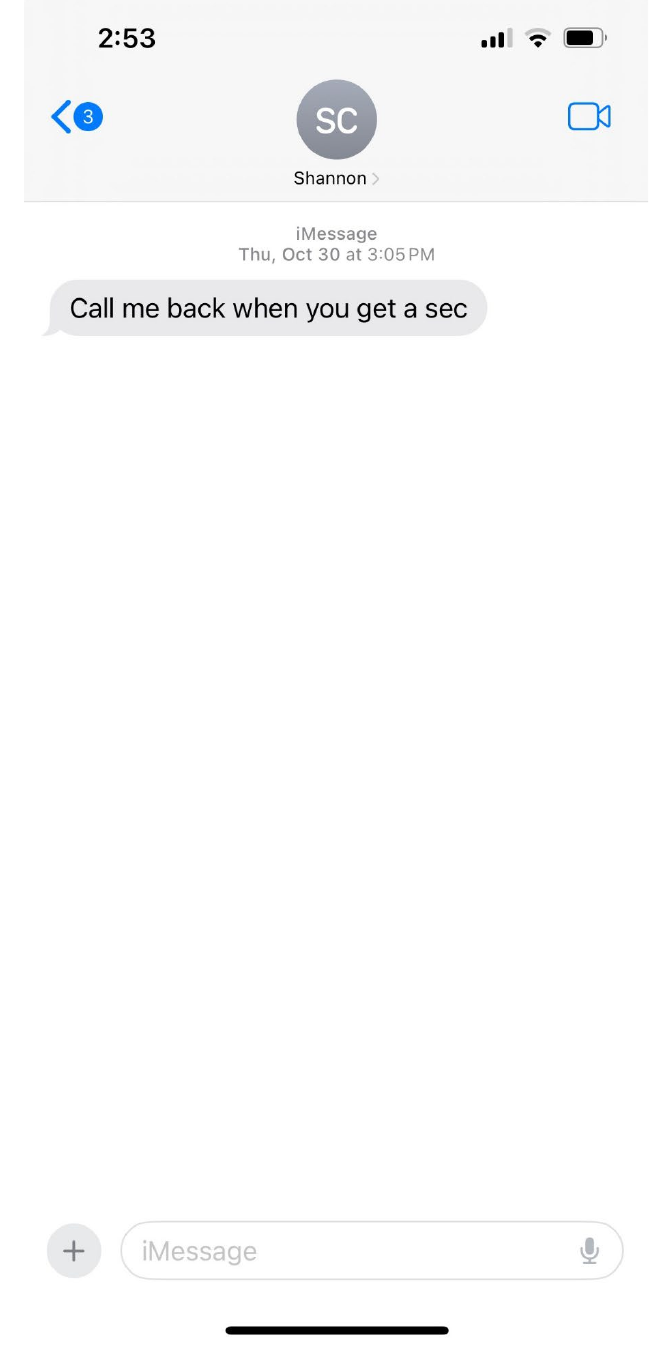
The exhibit. The Housing Director’s text thread with Shannon Cox Baker, Pennrose’s Regional Vice President. The contact is saved, with an avatar and a name. The thread contains one incoming message, with no reply and nothing above it.
The year is 2025. The screenshot shows “Thu, Oct 30.” The 30th of October fell on a Thursday in 2025. In 2024 it was a Wednesday and in 2026 a Friday.
The message assumes earlier contact. “Call me back when you get a sec” reads as a reply to something rather than the opening of a conversation.
The message falls one day outside the search window. The Town asked its staff for every text with the developer from 1 October 2023 to 29 October 2025. That twenty-five-month period, covering the RFP, the selection, the negotiation and the design work, produced nothing from this thread; the one message produced is dated 30 October, the day after the window closed.
Elsewhere in the same records release these two people are in regular contact: three voicemails, a press response sent over for review, and repeated meetings arranged between them. In one of those voicemails Cox Baker tells a councilwoman “you can also shoot me a text as well”, which indicates that she texts as a matter of course.
A single-message thread between those two people does not match the volume of contact documented everywhere else in the same release. That is an observation anyone can check against the other exhibits on this page. It is not a claim that anyone deleted anything, and this page does not make that claim.
Why this page does not say messages were deleted
A screenshot cannot prove deletion, and there are ordinary explanations that would produce exactly this image:
iPhones delete messages automatically. iOS has a setting called Keep Messages, with options of 30 Days, 1 Year, or Forever. If a phone is set to 30 days, everything older is removed automatically without any action by the user.
The custodian chose what to screenshot. Officials searched their own phones and produced what they judged responsive. Producing one message is not the same as a thread containing one message.
A second custodian's production covers a longer period. A second county custodian produced text screenshots in the same week, under the same instruction, from a different phone. Hers contained messages dated 13 January 2025, 16 April 2025 and 19 September 2025. The search process was therefore capable of capturing older messages where they existed. Because the phones and their settings differ, this proves nothing about the Housing Director's device, but it removes the explanation that the process itself could not capture older messages.
The instruction to custodians was broad. The instruction reads: “Texts/direct messaging of any kind – whether iMessage, SMS, Google Meet, or other platforms… Between yourself and Pennrose (whether you were communicating with Pennrose individually or with multiple participants). All Pennrose representatives – i.e., attorneys, consultants, or agents, etc.” That instruction asks for the whole thread rather than for the messages the custodian judged relevant.
The remaining question is narrow: the Keep Messages setting on that device. It is visible in the phone's settings screen, it has a one-word answer, and answering it does not require anyone to allege bad faith.
Where these records came from, and where they stop
Everything here comes from the Town of Jackson’s release. Teton County declined to produce records on the same subject, no county commissioner was asked to search a device, and the record ends in November 2025.
Open the scope of the record
Everything on this page comes from the Town of Jackson’s records release. Teton County has made no comparable release, and no county records were obtained.
The custodians the Town Attorney asked to search are Town officers, Town staff and staff of the joint Housing Department. No county commissioner is among them.
Commissioner Carlman’s negotiating agenda appears here because a Housing Department custodian had received it and produced it from her own phone. Nothing in this release shows any commissioner being asked to search a device, and nothing shows what such a search would have found.
The County was asked, and declined. Item 2 of the request read “All communications about Pennrose LLC.” The County Attorney answered:
“This request is overly broad and would take considerable time to accumulate all of these documents. Pursuant to Wyoming Statute §16‑4‑402(c)(ii), the time it takes to answer public record requests cannot impair or impede the governmental entity’s ability to discharge its other duties. At this point, the county is very busy with other duties we are required to discharge.”
“There are some options. You can always just come to my office, and you and I can go through my files together and see if there are any documents that you would like me to make a copy of. Or you can limit or lessen the scope of your request… At this point, we do not have a ground lease with Pennrose LLC, but we do have an Option for a Ground Lease that is signed by all parties.”
RecordTeton County Attorney, written response to the public records request
The Town, holding a request over the same subject in the same period, circulated a search instruction to nine custodians and produced 448 pages.
Two governments jointly owned this land and jointly ran this process. What follows is drawn from one of them, and represents a minimum.
The record also stops in November 2025, because that is where the release ends. Obtaining it cost $500, which is what the Town charged to assemble and produce 448 pages. Extending it to the cancellation in July 2026 means filing again and paying again. Records that show how a $28 million public asset was handled should not sit behind a fee that decides who gets to see them.
One correction to the citation: the Public Records Act sits at W.S. 16‑4‑201 through 16‑4‑205. The provision carrying the “impair or impede” language is 16‑4‑202(c)(ii), and 16‑4‑402 falls in the public meetings article.
What the Public Records Act provides when a request is burdensome
The Act answers burden with time rather than refusal. A custodian has seven business days to say records are in use or storage, thirty calendar days to release, and where good cause prevents that, a release date agreed with the requester. If no date can be agreed, the requester may complain to an ombudsman designated by the Governor or petition the district court, either of which weighs whether release would impair the entity’s other duties.
Open the statutory text
“(ii) If a public record is readily available, it shall be released immediately to the applicant so long as the release does not impair or impede the governmental entity’s ability to discharge its other duties;”
“(iii) All public records shall be released not later than thirty (30) calendar days from the date of acknowledged receipt of the request unless good cause exists…”
“(iv) If good cause exists… the public records shall be released on a specified date mutually agreed to by the applicant and the governmental entity. If a release date cannot be agreed upon, the applicant may file a complaint with the ombudsman…”
“(v) The applicant may at any time file a complaint with an ombudsman designated by the governor or may petition the district court for a determination as to whether the custodian has demonstrated good cause… The ombudsman or the district court shall review the records in camera…”
RecordWyoming Statute 16-4-202(c)
Subsection (c)(ii) sets the condition for releasing a readily available record immediately. The burden consideration appears again at (c)(v), where it is a factor for the ombudsman or the district court in deciding whether a custodian has shown good cause.
A requester who cannot afford to file again has a route that costs nothing: the ombudsman designated by the Governor, available at any time under (c)(v).
The sequence, 23 October to 11 November 2025
The single message was sent three days after a 68‑page memorandum requesting state review went to Town and County officials, and days before the Town began asking those officials to search their own phones.
Open the day-by-day sequence
| Date | What happened |
|---|---|
| 23 Oct 2025 5:30 PM | A public town hall on housing finance is held at the Teton County Library’s Ordway Auditorium. The Mayor and councilmembers attend. |
| 27 Oct 2025 | A 68-page memorandum requesting procedural and statutory review is sent to state departments, with Town and County elected officials and their attorneys copied. |
| 30 Oct 2025 | The message above. 3:05 PM. |
| Week of 27–31 Oct 2025 | The records request that produced this release is filed. The Town Attorney describes it on 3 November as “last week the Town received a request for records concerning the Virginian project.” |
| 29 Oct 2025 | The last day of the period the Town searched. The window it set runs 1 October 2023 to 29 October 2025 — twenty-five months. |
| 3 Nov 2025 8:54 AM | The Town Attorney sends search parameters to Town staff: Norton, Ziem, Thompson, Weber, Toronto, Anthony, DeVries Robinson, Scarlata, Sinclair. |
| 3 Nov 2025 9:17 AM | The Housing Director forwards it onward: “By Wednesday COB, please provide me with anything you have per Lea’s parameters listed below.” |
| 3 Nov 2025 4:09 PM | The Town Clerk sends the spreadsheet of agendas and minutes mentioning “Virginian.” Ordinances and resolutions: none. |
| 4 Nov 2025 3:51 PM | The Mayor replies, reporting three unrecorded private meetings with the developer, a call he made to its architect, and a “90 Virginian” entry on his firm’s calendar he cannot account for. |
| 5 Nov 2025 | Text messages are produced by a county custodian. |
| 11 Nov 2025 12:21 PM | The Town Attorney closes out that custodian: “Malone – text messages. Task complete for this individual.” |
| 11 Nov 2025 1:25 PM | The Town Attorney closes out the Mayor: “Jorgensen – this completes his records.” |
The message sits three days after a 68-page memorandum went to state agencies and days before the Town began searching officials’ personal devices.
The search window the Town set for every custodian, the Housing Director included, runs 1 October 2023 to 29 October 2025, closing the day before the message above was sent.
Teton County’s mobile device policy, §12‑6
Under the County’s own policy, county business on a personal phone is county property, open to access and review, with no expectation of privacy. The County could have collected these records directly.
Open the policy text
Text messages about public business are public records. They also live on personal phones, which is why they are rarely produced and easy to lose. The Town Attorney asked officials individually to search their own devices. What came back is what is on this page.
Teton County has a written policy on this subject, set out below.
Teton County’s 2023 Policy Manual, §12‑6, addresses this situation.
“Users should also be aware that pursuant to the Wyoming Public Records Act, information contained on a County owned mobile device, or on a personally owned mobile device to the extent used for County business or used to access the County network, may be a public record and subject to public inspection.”
“All information or data that is contained or stored on any County owned mobile device, or personally owned mobile device, to the extent that the device is being used for County business… is the property of the County. Such information or data is at all times subject to access, monitoring, review and disclosure by the County… and there shall be no expectation of privacy.”
“Employees using their personal device for business purposes must understand and agree that their service records and/or communications may be subject to Wyoming Public Records requests.”
Teton County Policy Manual, 2023 Edition · §12‑6, Mobile Device Acceptable Use · violation “may be subject to discipline, up to and including termination of employment”
County business on a personal phone is county property rather than the employee’s. The county can access it, monitor it, review it and disclose it, and the employee has agreed there is no expectation of privacy in it.
So when a records request arrived, the county was not limited to asking people to look through their own phones and hand over what they judged responsive. Under its own written policy, the data was already its own to obtain.
This point does not depend on any view of the project itself. A government that holds the right to collect its own records directly, and instead asks each person to search their own device and select what counts, has chosen the method that produces the least. That is a process choice, it could have been made differently, and it can be changed by a memo.
The emails to the newspaper and the Mayor’s account
ReadThree emails in the record, each in the writer’s own words. In September 2025 the Housing Director sent a reporter’s questions, with her answers written in, to the developer for review before replying, and the developer asked for a sentence to be cut. In November 2025 the Mayor wrote to the Town Attorney that he had met the developer outside public meetings at least three times without keeping a record, and had called its architect to share his own concerns about the design. In June 2024 the Housing Director sent elected officials a rebuttal to a published letter and told them she was not sharing it with the newspaper.
30 September 2025 · A reporter’s questions, sent to the developer for review
At 2:00 PM the Housing Director forwards a reporter’s four questions and her drafted answers to Pennrose: “Shannon – please review. I need to email this to him by 3pm.” At 2:33 PM Pennrose replies: “All good. Although I would cut out the last sentence to the last question.”
Open the email chain
A reporter’s questions, sent to the developer for review
| 30 Sep 2025 | What happened |
|---|---|
| 1:48 PM | A Jackson Hole News&Guide reporter emails the Housing Director four questions about the funding gap. |
| 2:00 PM | She forwards the questions, with her answers written in, to Pennrose's Regional Vice President: “Shannon – please review. I need to email this to him by 3pm.” |
| 2:33 PM | Pennrose replies: “All good. Although I would cut out the last sentence to the last question.” |
The sentence the developer asked to remove explained how building more homes lets the developer raise more private money. The version as sent is not in the released records.
A government answers questions about its own project in its own words. Here the answers went to the counterparty in a live negotiation for approval, and the counterparty edited them, before the public received them through the newspaper.
4 November 2025 · The Mayor’s account of his private contact with the developer
Answering the Town Attorney’s records request, Mayor Arne Jorgensen writes that he met Pennrose representatives outside public meetings at least three times and made no record, and that he reached out to the project architect “to share my concerns that the surface parking option lacked a level of quality, nuance, and creativity that I would expect.”
Open the email
“I have met several times with Pennrose representatives outside of public meetings for project updates, usually around site design. I can recall three of these… I did not do any recording of these discussion.”
“I do remember one phone call or zoom with Andy Rockmore, Pennrose Architect… I had reached out to share my concerns that the surface parking option lacked a level of quality, nuance, and creativity that I would expect. I did not record or otherwise create a record of the discussion.”
RecordMayor Arne Jorgensen, written response to the Town Attorney, 4 November 2025
He also described searching his own architecture firm's laptop and Google calendar, where he found an entry marked “90 Virginian” at 8:00am on 30 January 2025 that he could not match to any Town record, with no indication of who he was meeting.
Design expectations for a building on public land are set by the full Council and Board in a noticed meeting, on a recorded vote. A single elected official has no authority to press his own expectations on a respondent outside that setting.
Here the Mayor, a practicing architect, contacted the developer’s architect during a live negotiation to tell him the surface parking option fell short of what he would expect, and kept no record of the call or of his meetings with the developer. The other respondents had no such access, and the public has only his later account of what was said. The rules section sets out what Wyoming’s bidding statute says about a town officer who favors one respondent.
7 June 2024 · A rebuttal for elected officials, withheld from the press
After a published letter questioned the public cost per unit, the Housing Director sent elected officials a corrections table and a letter from Pennrose, and wrote: “I am not sharing this with the Housing Trust, Shelter JH, or the News & Guide.”
Open the email
A rebuttal for elected officials, withheld from the press
After the Jackson Hole Community Housing Trust published a letter to the editor questioning the public cost per unit, the Housing Director sent every elected official a corrections table, the Trust’s letter, and a letter from Pennrose. Her closing paragraph:
“I am also sharing this with members of the Housing Authority Board and Housing Supply Board since I know they are also receiving some questions from the public. I am not sharing this with the Housing Trust, Shelter JH, or the News & Guide as this is meant to be informational for you all, my bosses.”
RecordApril Norton, “Public Investment at 90 Virginian Lane,” 7 June 2024
A staff response to published public criticism was circulated to elected officials and two appointed boards and deliberately kept from the organization that raised the criticism and from the newspaper that printed it.
Information about the project moved toward the developer and away from the press in both instances. In September 2025 the newspaper received answers the developer had reviewed first; in June 2024 the newspaper was excluded from a staff rebuttal by design. Neither is prohibited by any rule the Town or County has written, and both are the kind of conduct a no-contact rule and a plain policy on press communications would end.
The losing team’s letter and the meeting video
Read · WatchOn 3 August 2024 the four design professionals behind a losing proposal wrote to five elected officials that the elements which cost them the award had appeared in the winner’s plan. Two days later, at the joint meeting of the Town Council and County Commission, Councilmember Jorgensen addressed the letter from the dais, the team’s lead designer made the same objection in public comment, and I raised my concerns as a sitting Councilmember. All three moments are on the Town’s official video, which plays below.
3 August 2024 · The letter
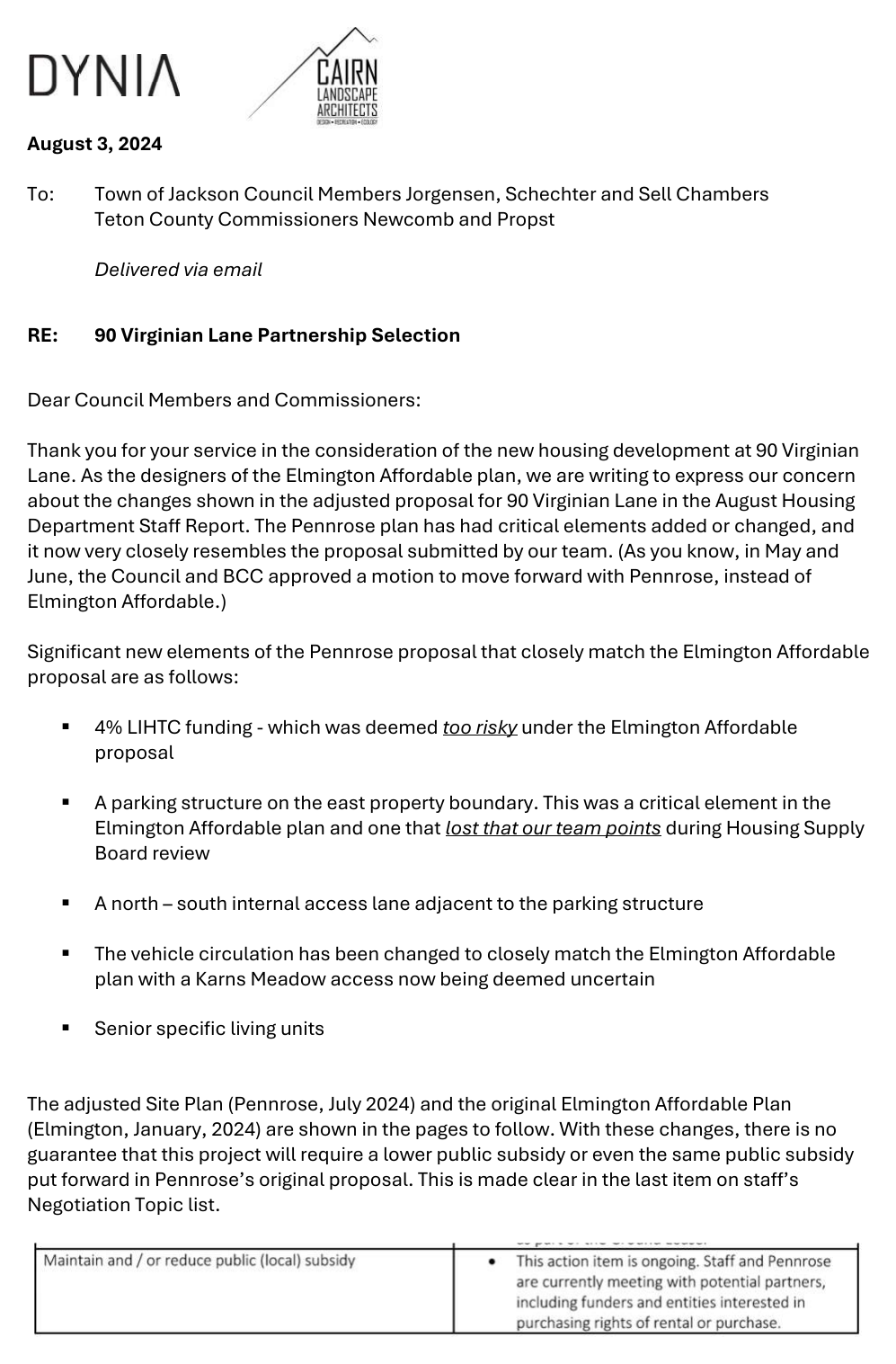
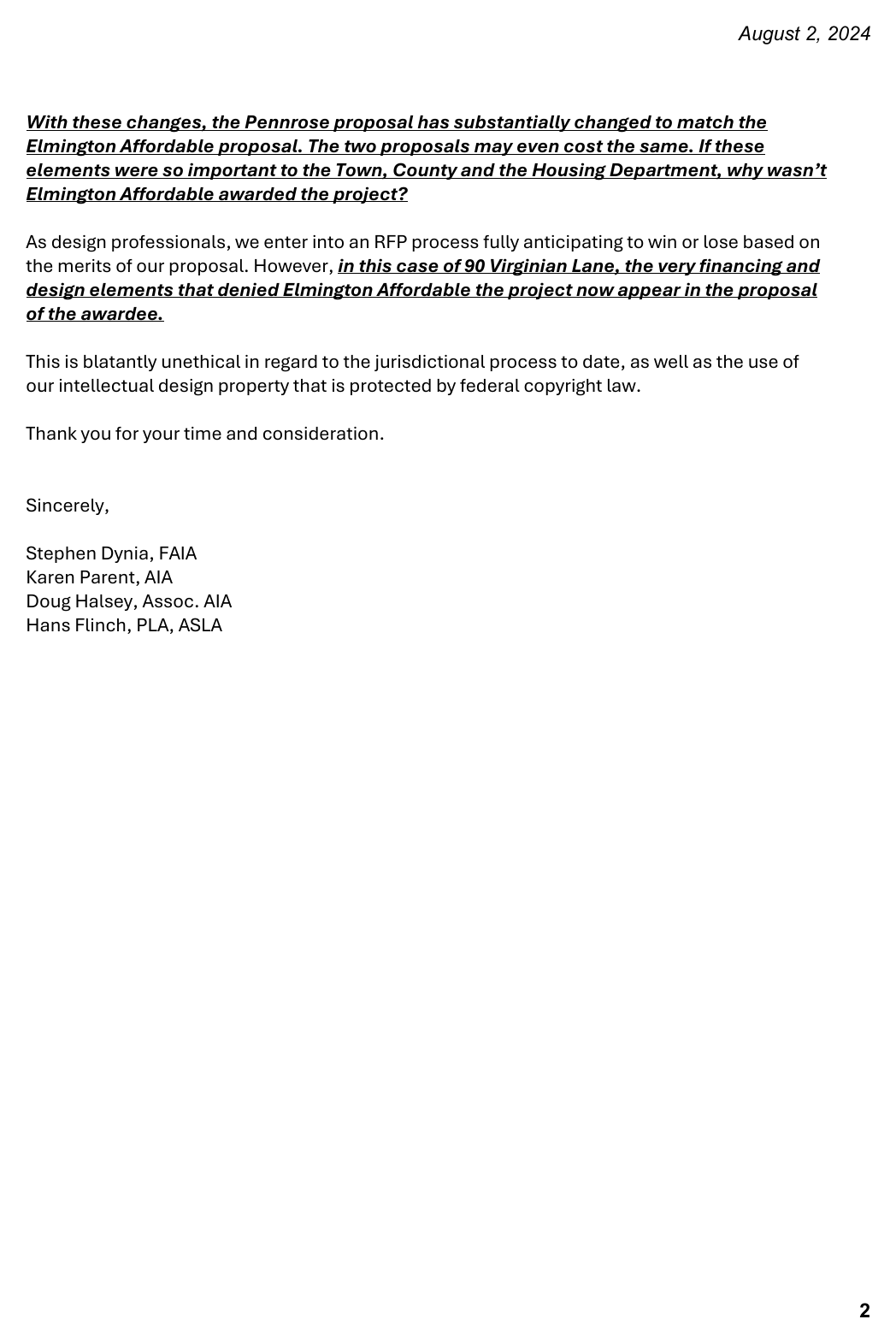
The letter lists five elements of the losing plan that appear in the winner’s adjusted site plan, including 4% LIHTC financing and a parking structure on the east boundary, and calls this “the use of our intellectual design property.” The Town Manager forwarded it to the entire Council.
Open both pages and the site-plan labels
Elmington plan submitted January 2024 · Pennrose plan adjusted 29 July 2024 · letter 3 August 2024
RecordOn 3 August 2024 the four design professionals behind the Elmington Affordable proposal — Stephen Dynia FAIA, Karen Parent AIA, Doug Halsey Assoc. AIA and Hans Flinch PLA ASLA — wrote to Councilmembers Jorgensen, Schechter and Sell Chambers and Commissioners Newcomb and Propst. The Town Manager, Tyler Sinclair, forwarded it to the entire Council on 5 August at 8:12 AM, copying the Town Attorney and the Housing Director.
Their letter says the adjusted Pennrose plan in the August staff report “has had critical elements added or changed, and it now very closely resembles the proposal submitted by our team.” It lists five:
- 4% LIHTC financing — “which was deemed too risky under the Elmington Affordable proposal”
- A parking structure on the east property boundary — “a critical element in the Elmington Affordable plan and one that lost… our team points during Housing Supply Board review”
- A north–south internal access lane adjacent to that structure
- Vehicle circulation changed to closely match the Elmington plan, with Karns Meadow access now deemed uncertain
- Senior-specific living units
“As design professionals, we enter into an RFP process fully anticipating to win or lose based on the merits of our proposal. However, in this case of 90 Virginian Lane, the very financing and design elements that denied Elmington Affordable the project now appear in the proposal of the awardee.”
“This is blatantly unethical in regard to the jurisdictional process to date, as well as the use of our intellectual design property that is protected by federal copyright law.”
Dynia, Parent, Halsey and Flinch to five elected officials, 3 August 2024 · forwarded to the entire Council by Town Manager Tyler Sinclair, 5 August 2024
The labels on the Pennrose drawing
The letter encloses both site plans for comparison. The Pennrose drawing is titled “ADJUSTED SITE PLAN · 29 JULY, 2024” and carries the Pennrose and SAR Architects logos. Its callouts read:
| Label on the Pennrose July 2024 plan | The corresponding item in the letter |
|---|---|
| “NEW STRUCTURED PARKING 250 SPACES” | “A parking structure on the east property boundary… one that lost… our team points during Housing Supply Board review” |
| “NEW N/S INTERNAL ACCESS LANE” | “A north – south internal access lane adjacent to the parking structure” |
| “STILL EVALUATING KARNS ACCESS” | “Karns Meadow access now being deemed uncertain” |
The word “NEW” is Pennrose’s own label; the drawing dated July 2024 marks these as additions, and the letter written eight days later identifies each as an element of the losing plan.
According to the letter, a parking structure on the east boundary cost the Elmington team points in the scoring, and four months later the same element appears in the winning plan labeled “new.”
The letter makes the same point about the financing: 4% LIHTC was judged too risky when Elmington proposed it and now appears in the adjusted Pennrose plan.
Their question is in the letter: “If these elements were so important to the Town, County and the Housing Department, why wasn't Elmington Affordable awarded the project?”
The meeting video, 5 August 2024
Each clip opens at the moment described, on the Town of Jackson’s official recording.
Watch Jorgensen’s comment
What he said, and what it means
“I’m an architect. I’ve been on your side of the equation many times. I have also been both in granted projects, where we’re asked to consider other things, or being part of the team that wasn’t selected, that saw our ideas show up in play. So I get that. It’s uncomfortable, but it’s what this process, the process we set up almost 10 years ago now, and this is playing out.”
TranscriptCouncilmember Arne Jorgensen, joint Town Council and County Commission meeting, 5 August 2024, during questions
Four design professionals had told five elected officials, in writing, that the elements which cost them the award had appeared in the winner’s plan, and that this was a use of work protected by federal copyright. The Town Manager forwarded that letter to the entire Council.
Jorgensen’s response at the meeting did not dispute that it had happened; he described it as uncomfortable, familiar from his own career, and consistent with how the process had run for about ten years.
No inquiry was opened, and no process existed for one.
Watch Stephen Dynia’s public comment
What he said
Thirteen minutes later, in public comment, Stephen Dynia, the lead designer on the losing proposal, made the same objection to all ten elected officials present: five Town Councilmembers and five County Commissioners, the two bodies that jointly own the land and jointly ran the process.
He praised the Pennrose design and objected to the process, not the competitor. He put a number on what it had cost his team: roughly $80,000. On deadlines: “if there’s a deadline, and the work will be evaluated when that is turned in, it should be abided.” On the order things were done in: “I know that form follows finance in the real world, right? And a project like this is about how the deal is structured.”
Watch Councilwoman Sell Chambers
Watch the entire joint meeting
About the full recording
The clips above are the moments that bear directly on the letter. The full recording of the meeting, several hours long, is the most complete public record of how the process ran.
Several speakers during the meeting raise the sequence in which these decisions were made; the recording shows who raised it and how directly it was addressed.
This is the cost of abandoning a competition after it has started. Eleven firms spent money on responses; one of them was marked down for ideas that later appeared in the plan that beat them, and the county code provided no process for them to take that objection to.
The letter says the proposals may by then have cost the same. If that is right, the basis on which the selection was made no longer held by August 2024, and the two governments continued with the project for another two years.
What this page does not claim. This page does not claim that anyone copied anything. The design team asserts reuse of their intellectual property; the developer has not answered that publicly and no court has decided it. What is established is that the letter was written, that it identifies five specific convergences, that it reached every elected official, and that no process existed to resolve it.
What happened
Scoring, the two-bidder vote, the zoning change, the private briefings
The RFP gave the most points to bidders asking for no public money beyond the land. On 14 May 2024 the Council voted 4–1 to negotiate with both finalists at once. The zoning change the winning design needed was adopted after bids closed. The Housing Director scheduled private briefings for every elected official with the developer invited and no minutes in the record, and the Mayor reported three unrecorded meetings with the developer.
Open the record
The scoring criterion for public subsidy
“Amount of Town, County, or Housing Authority Subsidy Requested. 50 points max. 50 = no additional Town, County, or Housing Authority subsidy.”
Record90 Virginian Lane Request for Proposals, Appendix G
A bidder scored highest on that criterion by asking for no public money beyond the land. Since the award, the public commitment has grown to include the $28 million parcel, up to $500,000 in design costs, and another $10 million.
Two bidders were negotiated with at once
On 14 May 2024 the Town Council voted 4–1 to negotiate with both finalists at the same time. The County Commission put the item off and never voted for it.
| Vote | Councilmember |
|---|---|
| Yes | Mayor Hailey Morton Levinson |
| Yes | Councilmember Arne Jorgensen |
| Yes | Councilmember Jonathan Schechter |
| Yes | Councilmember Jim Rooks |
| No | Councilmember Jessica Sell Chambers |
“We have one applicant with better design and another with better finances. So let’s ask one to improve the design and the other to improve the finances.”
TranscriptCouncilmember Jonathan Schechter, 14 May 2024
“I don’t know why they would both negotiate on the ground lease.”
TranscriptApril Norton, Housing Director, objecting at the same meeting
A sealed competition has one rule: everybody is judged on what they submitted, and nobody learns what anybody else submitted. Asking two bidders to keep improving after the deadline, each using what the other did well, ends the competition.
The Housing Supply Board had already recommended a single firm, and the Housing Director said at the meeting that she did not understand the decision. The Council voted to negotiate with both; the County never joined that vote, so from 14 May until the Council narrowed to Pennrose on 3 June the two governments were pursuing different courses.
Three months later, at the 5 August 2024 joint meeting, the architect for the losing team told both bodies in public comment that his firm had put roughly $80,000 of work into its bid, and that ideas from that bid had appeared in the winning design.
“I’m an architect. I’ve been on your side of the equation many times. I have also been both in granted projects, where we’re asked to consider other things, or being part of the team that wasn’t selected, that saw our ideas show up in play. So I get that. It’s uncomfortable, but it’s what this process, the process we set up almost 10 years ago now, and this is playing out.”
TranscriptArne Jorgensen, then Vice Mayor, 5 August 2024
The zoning rule changed after bids closed
The winning design needed a fourth story. The NH-1 zone did not allow one when the RFP went out. The Town's planning department proposed the change six weeks before the RFP was released, and the proposal named the parcel:
“Of the sites listed, only 90 Virginian Lane, Webster Laplant apartments, and Pioneer Homestead apartments sites contain over 2 contiguous acres of NH-1 land under single entity ownership… If approved, use of the options presented in this text amendment will be evaluated for implementation at 90 Virginian Lane for affordable housing.”
RecordTown of Jackson Planning & Building, file P23-168, 28 September 2023
Bids closed 2 February 2024. The change was reconsidered days later and adopted 16 April 2024. By adoption it had been narrowed from three qualifying parcels to two.
Bidders designed and priced without knowing whether the fourth story would be allowed. The rule was settled after their bids were in.
Zoning is meant to apply to areas, not to single properties. A rule drafted with a named parcel in mind, then narrowed before passing, raises the question of whether it was a general rule. Wyoming courts call a rule written for a single property spot zoning.
Private briefings scheduled for every elected official
Calendar records released by the Town show the Housing Director scheduling private briefings with each elected official of both bodies, with the developer and its architects invited to every one. The records contain no minutes of any of them.
| Date | Time | Elected officials invited |
|---|---|---|
| 27 Aug 2025 | 8:30 AM | Natalia Macker, Luther Propst |
| 27 Aug 2025 | 10:00 AM | Mayor Arne Jorgensen, Devon Viehman |
| 27 Aug 2025 | 1:00 PM | Kevin Regan, Wes Gardner |
| 27 Aug 2025 | 2:30 PM | Mark Newcomb, Alyson Spery |
| 27 Aug 2025 | 4:00 PM | Len Carlman |
| 22 Sep 2025 | 9:30 AM | Jonathan Schechter, Arne Jorgensen |
The same non-elected people were invited to all five sessions on 27 August: April Norton; Shannon Cox Baker of Pennrose; Andy Rockmore and Allison Brandt of SAR Architects; Brendan Schulte of Jorgensen Associates; Brett McDonough of Shaw Construction. A separate 11:30 AM session for Councilwoman Viehman was canceled and combined with the Mayor’s. The 22 September session was a Microsoft Teams meeting that also included Michael Kimmelman of Pennrose and Town Manager Tyler Sinclair. Calendar invitations record who was invited rather than who attended. JSCVirginian000001, 000002, 000014.
Ordinances, resolutions, and the public record
When the Town Clerk searched the Town’s records for “Virginian,” she produced a list of agendas and minutes. Under ordinances and resolutions she reported none.
Ordinance, resolution, motion
Ordinances and resolutions are numbered, indexed and published, so anyone can look them up years later. Every authorization in this project was instead a motion recorded in the minutes of a single meeting, which you can only find if you already know the date.
Open the explanation
An ordinance or a resolution is a numbered, indexed, formally published instrument that anyone can look up years later without knowing which meeting to search.
A motion recorded in meeting minutes is binding but is not numbered, indexed, or separately published; it exists only in the minutes of one meeting, and a reader has to know the date to find it.
Every authorization in this project was made by motion: the $28 million land purchase, the direction to negotiate, the Ground Lease Option Agreement, the $250,000 of design money, and each deadline extension. None exists as a numbered instrument a resident could look up.
Authorizing by motion is lawful and common. The objection here is to findability rather than legality: the largest housing project in this community’s history produced no formal instrument bearing its name, so there is nothing to look up.
How the meetings were labeled in the Clerk’s list
The Clerk’s list records how the meetings were labeled. The sessions of 2 October 2023, 6 November 2023, 6 May 2024, 14 May 2024 and 5 August 2024 are labeled JIM — Joint Information Meeting. From 7 October 2024 onward they are labeled JM — Joint Meeting.
The 6 November 2023 session is the one where the Council voted 5–0 and the Board 4–0 to approve the RFP and direct its release. The 14 May 2024 session is where the Council authorized negotiating with two respondents at once.
Binding direction was given at meetings labeled as information meetings. That may be longstanding local shorthand, and this page does not claim otherwise; the naming is the Clerk’s. What the rules permit a body to decide at a meeting it has called an information meeting, and why the label changed in October 2024, are questions the records do not answer.
The Mayor’s written response to the Town Attorney, describing at least three unrecorded meetings with the developer and a call to its architect, is set out in full in the emails section.
The exchange in which the Housing Director sent a reporter’s questions and her answers to the developer for review is set out in the emails section.
Five departures from competitive process
Five events, with their dates
The rules changed after the bids were in; the zoning change narrowed while the competition was live; the government negotiated with two finalists at once; the affordability mix changed after selection; and the selected developer had private communications with officials and staff.
Open the five events
A competition depends on two conditions: that everyone bid on the same terms, and that no bidder had private access to the buyer. Each of the events below removed one of those conditions.
Five such events, in addition to the letter described above, are set out below with their dates.
The rules changed after the bids were in
8 Nov 2023 RFP released · 2 Feb 2024 bids due · ~5 Feb 2024 zoning reconsidered
RecordThe RFP went out on 8 November 2023 with responses due 2 February 2024. Eleven firms responded. A Town land development regulation amendment, P23-168, would allow four stories and 48 feet in the zone containing the site. It came back for reconsideration in the first week of February 2024, after the bid deadline, and carried by a single vote. Final adoption followed on 16 April 2024.
Eleven companies spent months designing and pricing against the rules in force on 2 February. Three days later those rules changed, by one vote, in a way that permitted substantially more building on the land.
Every proposal was then priced against rules that no longer applied. None of the ten firms that did not win was given a chance to revise its numbers, and the firm that won received the benefit of rules no one had bid under.
What normally happens. When something material changes before award, the buyer issues an addendum and extends the deadline so everyone can revise, or cancels and reissues. Either step is routine, costs weeks, and keeps the comparison valid; neither was done here.
I was in that room and voted against the amendment. The vote was close enough that a single member changed the outcome. In my view, the passage of a rule that nearly failed, days after a bid deadline, on a change that benefited the parcel being bid, is the point at which this stopped being a fair competition, and every later step inherited that problem.
The zoning change got narrower while the competition was live
Proposed 28 Sept 2023 · adopted 16 April 2024
RecordAs proposed, P23-168 named three qualifying sites: 90 Virginian Lane, Webster Laplant apartments, and Pioneer Homestead apartments. As adopted, it applied to two. The transmittal memo said: “If approved, use of the options presented in this text amendment will be evaluated for implementation at 90 Virginian Lane for affordable housing.”
A zoning change is supposed to be a general rule that applies to a class of property rather than to one owner's parcel. Writing one for a single site is called spot zoning, and Wyoming courts look at whether a change serves the general welfare or a private interest.
This one was narrowed during processing while a solicitation naming one of its sites was open. A rule aimed at three sites reads as a policy; a rule narrowed while bids are being taken on one of the remaining sites raises the question of whether it was written for a project.
Wyoming standard: Laughter v. Board of County Commissioners, 2005 WY 54.
The government negotiated with two finalists at the same time
14 May 2024 – 3 June 2024
RecordOn 14 May 2024 the Town Council voted, in the government's own written words, “to direct and authorize the Housing Authority to direct staff to negotiate a Ground Lease and Development Agreement including the agreed upon internal procedures and negotiation topics with both Pennrose Development and Elmington Affordables, LLC.”
The County Board did not join that vote; it continued the item and acted on 21 May, naming Pennrose only. The Council narrowed to Pennrose alone on 3 June.
An RFP ends with the selection of one respondent. For roughly three weeks two companies were in separate private negotiations over the same piece of public land, neither able to see the other's terms, and the two governments that jointly own that land had not agreed on which company they were negotiating with.
Negotiating privately with two bidders after the public competition had closed amounted to a second, private round of bidding that the RFP did not provide for.
On 3 August 2024 the design team working with Elmington wrote to five elected officials objecting to the process. Teton County's procurement code contains no process for receiving a bid protest, so no body was assigned to consider the letter.
Changes to the affordability mix after selection
March 2024 selection · June 2024 · April 2025
RecordAffordability mix was the central criterion on which eleven firms were compared. Pennrose was named the leading candidate on 20 March 2024.
On 7 June 2024 the Housing Director wrote to the entire Board and Council: “Work to explore an increased number of permanently deed-restricted Affordable units and/or deeper Affordability restrictions is already underway, based on the key negotiation points identified by the Board and Council at your May Joint Information Meeting.” She attached a letter from the developer confirming progress on it.
On 17 April 2025 the developer reported to both bodies that a market study had reduced expected revenue from the 120–160% of median income homes and the workforce homes.
The winning proposal was selected on a particular mix of income tiers. That mix was then renegotiated in both directions over two years: deeper restrictions were explored in 2024, and revenue expectations from those same tiers were cut in 2025.
A score based on a mix that changes after scoring no longer measures what it was meant to measure. Within three months, the proposal the ten losing firms had been compared against was no longer the proposal being negotiated.
The concern was raised in writing at the time. A respondent's design team wrote to elected officials in June 2024 that they found “the income mix proposed by Pennrose to be really troubling as it is not backed up by the Housing Supply needs data.”
Private communications with the selected developer
April 2025 – September 2025
RecordFour documented instances, all inside the government's own records release:
- 16 April 2025. A county commissioner's negotiating agenda is forwarded to the developer's regional vice president, hours before his private meeting with the company.
- 24 April 2025. The Housing Director asks the developer for the template for the cost‑share agreement she is about to attach to her own staff report. The developer replies one minute later: “Yes, we can work on this.”
- 27 August 2025. Five private briefings scheduled in a single day at the Teton County Library, covering nine of the ten elected officials singly or in pairs, with the developer and its architect invited and no minutes in the record.
- 30 September 2025. The Housing Director sends a reporter's questions, with her answers already drafted, to the developer for review before the reporter receives them.
Once a government is talking privately to one company about a live public deal and keeping no record of it, nobody outside the room can check what was said, offered, or agreed. The public's only view of the deal is whatever the two sides decide to report afterwards.
None of it broke a written rule, because no written rule existed. The rules section sets out what the governing documents say.
Who did what
Two people, and what the records show about each
Commissioner Len Carlman’s negotiating agenda reached the developer before his own meeting. Housing Director April Norton organized every private briefing, obtained the staff-report template from the developer, and sent the Town’s press answers to the developer for review. The Ethics Act reaches him; no statute reaches her.
Open the two records
Two people appear throughout the records. Both are public figures acting in public roles, and everything below comes from the government’s own release. Each entry closes with the limits of what the documents establish.
Len Carlman
Teton County CommissionerThe record
16 April 2025, 10:56 AM. A message headed “From Len:” is forwarded by Housing Director April Norton to Shannon Cox Baker, Pennrose's Regional Vice President. It confirms a meeting at 2:30 that afternoon “at your office with you and colleagues from Pennrose” and sets out what he intends to raise:
“The two things that I have on my agenda are: securing priority housing for essential public sector workers in return for additional public sector investment; and, what seems like it should be a little thing, ensuring that designs for the common area include features…”
MaloneText, page 2, public records release
Cox Baker replies in the same thread: “Just reviewed this with Andy at United gate.” Andy Rockmore is the project architect. The commissioner's terms reached the design team before the commissioner's meeting took place.
27 August 2025, 4:00 PM. Scheduled for a private briefing at the Teton County Library with the developer's team and the architect; the records contain no minutes.
14 July 2026. Votes against terminating the relationship with Pennrose.
What this means
The message proposes priority housing for essential public sector workers in return for additional public sector investment, which is a trade: a benefit to the public in exchange for a larger amount of public money.
No single elected official can offer that. Who gets priority for the homes and how much public money goes in are terms of the deal, and those terms are decided by the full body in a noticed meeting on a recorded vote.
The additional public money under discussion was $10 million. The Town and the County had not agreed how to split it in April 2025, and had still not agreed by the day the project was canceled.
Applicable Wyoming law
Wyoming's Ethics and Disclosures Act says a public official “shall not disseminate to another person official information which the public official obtains through or in connection with his position, unless the information is available to the general public or unless the dissemination is authorized by law.” W.S. 9‑13‑105(c)
The Act defines a public official as “an individual elected to a state or local office.” A county commissioner is within that definition. Violation is a misdemeanor and is “sufficient cause for… removal of a public official.”
What this page does not claim
This page does not claim that he sent anything to the developer himself; the record shows his message being forwarded by someone else.
It does not claim that a violation occurred; whether this provision was broken is a question for a prosecutor, and “official information” is not defined anywhere in the Act.
It does not claim that this was a closed-meetings violation; one commissioner is not a quorum, and the Open Meetings Act does not apply here.
April Norton
Director, Jackson/Teton County Affordable Housing DepartmentThe record
| Date | What the records show |
|---|---|
| 16 Apr 2025 10:56 AM | Forwards Commissioner Carlman's negotiating agenda into a text thread with the developer's regional vice president. |
| 24 Apr 2025 11:38 AM | Asks the developer for the template for the cost‑share agreement she intends to attach to her own 8 May staff report: “Do you have a template you'd like to use?” Reply at 11:39: “Yes, we can work on this.” |
| 27 Aug 2025 | Schedules five private briefings in one day — nine of the ten elected officials, singly or in pairs, with the developer and architect invited and no minutes in the record. |
| 30 Sep 2025 2:00 PM | Sends a reporter's questions with her answers drafted in to the developer: “Shannon – please review. I need to email this to him by 3pm.” |
| 3 Nov 2025 9:17 AM | Forwards the Town Attorney's personal-device search instructions to her own staff. |
What this means
In each of these, information moved from the public side toward the developer: the staff report template came from the company the report was about, the answers to a reporter went to the company for review before the reporter received them, and an elected official's negotiating position went to the company before his meeting.
Nothing in the release shows the company's material reaching the public first.
Applicable Wyoming law
The Ethics Act does not apply to her. The Act covers public officials (elected), public members (part-time appointees to state boards), and public employees — which the Act defines as a specific list of senior state positions, such as the attorney general and state department directors. A county housing director is none of the three.
The bidding statute also does not apply to her. W.S. 15‑1‑113(j) binds “any officer or employee of the city, town or joint powers board.” She is a county employee, and the Housing Authority is a regional housing authority created under W.S. 15‑10‑116(b) — not a joint powers board. The rules section sets this out.
The remaining applicable rules are the county’s own personnel policies. Teton County Policy Manual §2‑6 tells employees that confidential information “should not be disclosed except with authorized personnel,” and §12‑6 makes county business on a personal device county property. Both carry employment discipline as their strongest consequence, and neither defines what counts as confidential.
The person who organized every private briefing, asked the vendor for a template, and sent the government’s press answers to the vendor for review is outside both statutes that would have governed an elected official doing the same things.
What this page does not claim
This page does not claim that briefing elected officials is improper; it is routine, lawful, and part of the job. What is different about these briefings is that the developer and its architect were invited into the room during a live procurement, and the records contain no minutes.
It does not claim that any county rule was broken. What Teton County's 2023 Policy Manual does say, at §2‑6, is that employees “may have access to information of a confidential nature” which “should not be disclosed except with authorized personnel,” and that misuse or disclosure “could result in personal legal liability and disciplinary action, up to and including termination.” It does not define what counts as confidential, it is a personnel policy rather than law, and its only remedy is employment discipline. Whether it was ever applied here is not something this page knows.
She announced her resignation in 2026; the remedies proposed here are institutional rather than personal.
None of this requires anyone to have acted in bad faith. It requires only that a group of people did what the last ten years of practice had made normal, inside a system with no written rule telling them otherwise. The fix is therefore a set of written rules rather than resignations, and rules get written only when people see what their absence produced.
Contact rules and Wyoming law
No contact rule, and the statutes that apply anyway
No document governing this procurement restricted contact between bidders and officials. Wyoming statute 15‑1‑113(j) still makes favoring one respondent by giving or withholding information malfeasance that vacates the office, and lets ten electors compel a hearing; the Ethics Act reaches every elected official; no statute reaches department staff. Park City’s RFP shows the one-paragraph rule that would have made the analysis unnecessary.
Open the full analysis
Two separate questions need to be answered here: whether any rule restricted contact, and whether Wyoming statute reaches the conduct the records show.
There was no rule restricting contact between a company bidding and the officials deciding. None of the four documents checked contains one.
A Wyoming statute does prohibit the conduct the records show. It carries a penalty, provides a remedy, and gives ordinary residents a way to invoke it.
No contact rule existed
| Document | Contact rule |
|---|---|
| The 90 Virginian Lane RFP, 45 pages | None |
| NIGP Code of Ethics | None. Applies to procurement staff, not elected officials or companies |
| Teton County Code Title 2, Procurement | None. Also has no process for a losing bidder to protest |
| Wyoming Statute 15-1-113 | No contact rule — but see below |
The private meetings broke no contact rule, because none existed. The gap is in the documents rather than in any one person’s conduct, and a governing body can close it at any meeting by adopting one.
What W.S. 15‑1‑113(j) says
Wyoming Statute 15‑1‑113 is titled Contracts for public improvements. Subsection (j) reads in full as follows.
“Any officer or employee of the city, town or joint powers board who aids any bidder or respondent in securing a contract to furnish labor, material or supplies at a higher or lower price than that proposed by any other bidder or respondent, or who favors one bidder or respondent over another by giving or withholding information, or who willfully misleads any bidder or respondent in regard to the character of the material or supplies called for, or who knowingly certifies to a greater amount or different kind of material or supplies than has been actually received, is guilty of malfeasance, which renders his office vacant.”
RecordWyoming Statute 15-1-113(j) · Legislative Service Office compilation of Title 15
“Who favors one bidder or respondent over another by giving or withholding information.”
The offense does not require a bribe, a kickback or a hidden financial interest. Giving information to one respondent and withholding it from the others satisfies the section, and the penalty is that the office is vacated.
The records on this page show a commissioner’s negotiating terms relayed to one company; private briefings scheduled with that company in the room and no minutes; a staff report template supplied by that company; and the government’s answers to a reporter sent to that company for approval. In each instance information went to one party and not to the others, over a period of two years.
Three objections to applying the statute
Three arguments are usually raised against applying this statute here: that it covers sealed bids only, that it misses the Housing Authority, and that no court has tested it. The first is contradicted by the statute’s own text, the second is correct, and the third limits how far the statute reaches without removing it.
Open the full analysis
Whether the statute covers an RFP
The objection is that the statute applies only to sealed bids. The statute’s text does not support that reading. Subsection (a) requires contracts to be “advertised for bid or for response if a request for proposal or qualification… is used,” and subsection (j) protects a “bidder or respondent” in each clause. “Respondent” is the term for a party to a proposal process rather than a bid, so the legislature included proposal processes in this section deliberately.
That sentence in (a) names three delivery methods: construction manager agent, construction manager at risk, and design-builder. The government’s own meeting invitation describes the arrangement used here.
“I’m reaching out to invite you to an introductory meeting with our development partner at 90 Virginian Lane: Pennrose, LLC…”
“Participants: Town & County staff, Pennrose LLC, SAR Architects, Jorgensen Associates, Shaw Construction”
RecordApril Norton, meeting invitation, 6 August 2024 · JSCVirginian000008
A developer, architect, civil engineer and general contractor working as one team is what design-build means. The same four firms were invited to the private briefings: Shannon Cox Baker of Pennrose, Andy Rockmore and Allison Brandt of SAR Architects, Brendan Schulte of Jorgensen Associates, and Brett McDonough of Shaw Construction.
Two qualifications apply: the RFP itself never uses the words “design-build,” and the government was leasing land to a company that would own the improvements for ninety-nine years rather than buying a building for itself. Whether this was design-build within the meaning of the statute remains open to dispute.
Whether the statute covers the Housing Authority
Subsection (j) binds “any officer or employee of the city, town or joint powers board.” The Housing Authority is not a joint powers board. Its own ground lease says what it is, in the first line of the preamble:
“Optionor is a duly constituted housing authority in the State of Wyoming pursuant to Wyo. Stat. §15‑10‑116(b).”
RecordGround Lease Option Agreement, preamble
That statute creates a regional housing authority — a “public body corporate and politic” formed when two or more municipalities or counties resolve to have their housing powers exercised jointly. It is created by resolution and is a distinct entity from a joint powers board, so the bidding statute does not reach the Authority or its staff by that route.
Whether an untested statute has any effect
The section governs contracts for public improvement and excludes professional services, and no Wyoming court has decided whether a ground lease structured like this one falls inside it. That question remains open.
The reference to requests for proposal in subsection (a) is written around construction-manager and design-builder delivery, so the section does contemplate proposal processes, and a housing development on public land does not fit easily within an exclusion written for consulting engagements.
Who each statute covers
Once the Housing Authority question is settled, two laws apply, and between them they reach almost everyone involved.
| Who | Bidding statute 15-1-113(j) | Ethics Act 9-13-105(c) |
|---|---|---|
| Mayor and Town Councilmembers | Yes — officers of the town | Yes — elected to local office |
| County Commissioners | No — Title 15 governs cities and towns | Yes — elected to local office |
| Housing Authority commissioners | No | Only if separately elected to office |
| Housing Director and Department staff | No — county employees, not town or joint powers board | No — “public employee” is limited to senior state positions |
The Housing Authority is sometimes described as a separate operator. The form of the Council’s own motion shows the chain of direction:
“To direct and authorize the Housing Authority to direct staff to negotiate a Ground Lease and Development Agreement… with both Pennrose Development and Elmington Affordables, LLC.”
The direction ran from the Council to the Authority to staff. The Authority exercises housing powers only because the Town and County elected to have it do so. Every material step in this project — releasing the RFP, authorizing negotiation, approving lease terms, committing the design money, extending the deadlines, terminating — was a vote of the Council and the Board. The Mayor and Councilmembers who gave those directions are town officers, and subsection (j) applies to them directly.
Every elected official in this story is covered by one statute or the other, and the Mayor and Council are covered by both. The gaps in the two statutes do not overlap for elected officials.
Nobody on staff is covered by either. The only written rules reaching the Housing Director are Teton County’s own Policy Manual §2‑6 and §12‑6, whose strongest remedy is employment discipline. That gap is in Wyoming law rather than in this project alone, and a local no-contact rule would close it.
The housing authority statute has its own removal provision. Under W.S. 15-10-117, a commissioner of a regional housing authority may be removed by the body that appointed them “for inefficiency, neglect of duty or misconduct in office” — after a hearing, with ten days’ notice and the charges in writing, and with “a record of the proceedings, together with the charges and findings thereon” filed with the clerk.
What the bidding statute does where it applies
Four subsections, and what each one does
Where the statute applies it vacates the office of an official who favors one respondent, lets ten residents compel a public hearing, voids the contract and allows the money to be recovered, and requires every covered contract to carry a clause naming the statute.
Open the subsection table
| Subsection | Effect |
|---|---|
| (j) | For a town officer or employee, favoring a respondent by giving or withholding information is malfeasance, which renders the office vacant. |
| (k) | Ten qualified electors can sign a charge and the governing body must hold a hearing. It may compel the attendance of witnesses and the production of papers, and it must make findings of fact and conclusions of law. |
| (o) | A contract made in violation of the section is void, and money paid on it “may be recovered without restitution of the property or benefits received or retained.” |
| (p) | “Every contract of the kind specified in this section shall contain a provision expressly referring to this section and making it a part of the contract.” |
If this statute applies, every covered contract is required to carry a clause pointing at it.
No instrument in this project contains one. The RFP, the Development Agreement, and the Ground Lease Option Agreement, which cites five other Wyoming statutes, all omit it. Either a determination was made that the section did not apply and no record of it survives, or the question was never reached. Either possibility calls for an explanation.
Unlike most laws of this kind, which depend on a prosecutor, this one can be invoked by residents. Ten qualified electors sign a charge, and the governing body is obliged to hold a hearing, with the power to compel testimony and documents and a duty to issue written findings. The hearing does not depend on anyone in office choosing to open it.
I think this section reaches the Town’s elected officials, and that the conduct in these records is the conduct subsection (j) describes: one respondent was given information the others were not, over two years and by more than one person.
Where it does not reach — county commissioners, the Housing Authority, department staff — the Ethics Act covers the elected officials, and no statute covers the staff. The absence of any rule for staff is the gap that needs attention.
I am not a court and cannot decide any of it. Nobody has yet been asked the question, and subsection (k) gives ten residents a way to have it asked.
Park City’s no-contact clause
None of the statutory analysis above is necessary if the solicitation states the rule itself.
Park City, Utah is a comparable town, a western resort community with a housing crisis, and its Woodside Park project is a comparable project: affordable housing on city land, with a public facility attached. Its RFP places the no-contact clause on page one, under the site photograph, before anything else.
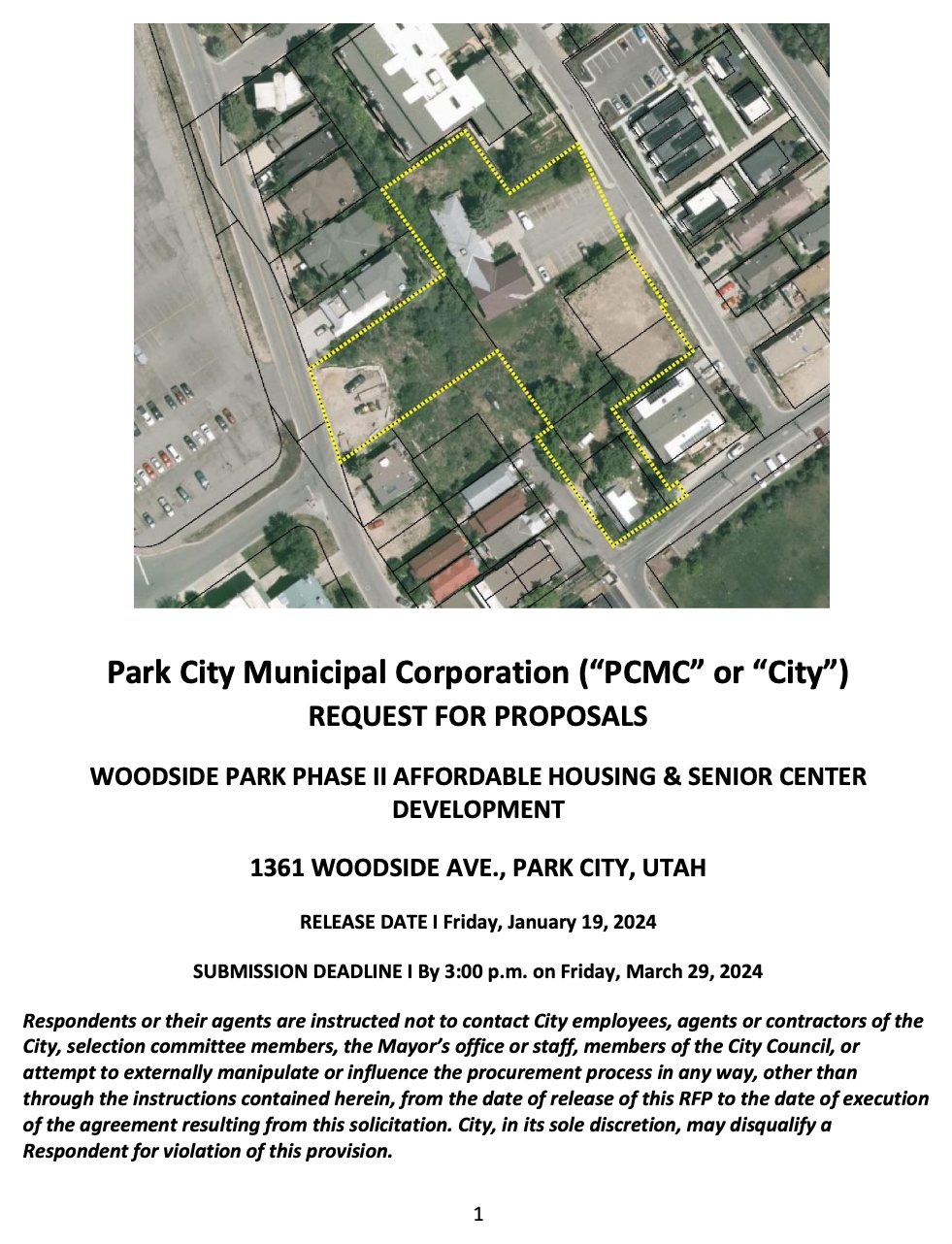
“Respondents or their agents are instructed not to contact City employees, agents or contractors of the City, selection committee members, the Mayor’s office or staff, members of the City Council, or attempt to externally manipulate or influence the procurement process in any way, other than through the instructions contained herein, from the date of release of this RFP to the date of execution of the agreement resulting from this solicitation. City, in its sole discretion, may disqualify a Respondent for violation of this provision.”
RecordPark City Municipal Corporation, RFP page 1, released 19 January 2024 · published at parkcity.gov
Park City released that RFP on 19 January 2024. Responses to the 90 Virginian Lane RFP were due 2 February 2024 — fourteen days later.
The two solicitations were live at the same time, in comparable towns, for comparable projects. Park City’s told every company, on its first page, that contacting a councilmember could result in disqualification; the 90 Virginian Lane RFP contained no contact rule.
What the clause does that Wyoming statute does not
| Park City’s clause | What it solves |
|---|---|
| Names the Mayor’s office, staff, Council members and the selection committee | No argument about whether an elected official is an “officer or employee” of anything |
| Triggers on contact | Nobody has to prove what was said in a room where no minutes were kept |
| Runs to execution of the agreement, not to award | Covers the negotiation period, when everything on this page happened |
| Disqualification, at the City’s sole discretion | A consequence available within days, rather than a malfeasance finding years later |
The third row is the one I would put in front of the Council. At 90 Virginian Lane no development agreement was ever signed. Everything on this page — the briefings, the commissioner’s agenda, the press answers, the template — happened during negotiation, after selection and before any contract existed, and Park City’s clause covers that period.
The reform is a single paragraph, it costs nothing, and a town of comparable size was already using it while we were taking bids without one.
The Wyoming Ethics and Disclosures Act
The Wyoming Ethics and Disclosures Act applies to elected officials directly, and does not depend on how a contract is classified.
“A public official, public employee or public member shall not disseminate to another person official information which the public official, public employee or public member obtains through or in connection with his position, unless the information is available to the general public or unless the dissemination is authorized by law.”
RecordWyoming Statute 9-13-105(c), Misuse of office
The same section also says a public official shall not use public funds, time, personnel, facilities or equipment “for his private benefit or that of another” unless the law authorizes it.
The Act defines “public official” to include, by name, “mayor and member of the council of a municipality” and “county commissioner.” Every elected official in this story is covered.
It probably does not cover the Housing Director. The Act’s definition of “public employee” is limited to senior state government positions. A local department head appears to fall outside it, and a good deal of the conduct on this page is hers.
Section 9-13-109 makes a violation a misdemeanor carrying a fine of up to $1,000, and states that a violation “constitutes sufficient cause for termination of a public employee’s employment or for removal of a public official or public member from his office or position.” The statute makes removal available rather than automatic.
How the two laws fit together
They cover different people, and between them they cover every elected official here.
Statute 15‑1‑113(j) binds officers and employees of a town or city. That reaches the Mayor and the Council. Its open question is whether this contract is the kind the section governs.
The Ethics Act binds anyone elected to a state or local office, with no threshold question. That reaches the Mayor, the Council and the County Commissioners.
Neither reaches department staff. The bidding statute is a Title 15 provision for towns, cities and joint powers boards; the Ethics Act limits “public employee” to senior state positions. For staff conduct the only written rules are the county’s own Policy Manual, and its strongest consequence is employment discipline.
Why Wyoming has no statewide no-contact rule
Wyoming splits this across titles. Title 9 is administration of government, where the ethics act lives. Title 15 is cities and towns. Title 16 covers public meetings, public records and joint powers. Title 18 is counties.
None of them imposes a no-contact rule on local procurement. Wyoming regulates conduct through the ethics act, and leaves bid procedure to each local government’s own procurement code.
The state left the rule to the county to write, and Teton County Code Title 2 does not contain one.
The report card
The procurement playbook, graded
The standard public-procurement playbook, stage by stage, set against what happened here, with an overall grade and the seven written rules that would close the gaps.
Open the report card and the seven rules
Public buying has a standard playbook that is taught, published, and used by governments everywhere, including small ones with small budgets. Below is that playbook, stage by stage, against what happened here.
The standard in each row is drawn from the NIGP Code of Ethics, ordinary public-procurement practice, Wyoming statute, and Teton County's own procurement code.
The facts are from the records. The grades are one person's assessment — they are analysis, not record, and you can switch them off with the button at the top of the page along with everything else marked analysis.
1 · Settle policy and zoning before you ask for bids
Standard: bidders must know the rules they are designing to. Unresolved zoning means nobody can price the job.
The zoning amendment governing height on this site was in process when the RFP went out, was resolved by one vote after the bid deadline, and was narrowed toward the site during processing.
2 · Use the right instrument
Standard: an RFP fixes the scope and compares priced proposals. An RFQ finds a qualified partner and works the scope out together. Pick by what is needed.
An RFP was used, then the scope was renegotiated for two years — which is RFQ behavior run through an RFP. Nearly everything downstream follows from this choice.
3 · Put the ground rules in the solicitation
Standard: a no-contact clause, a single point of contact, published evaluation criteria, and a written protest process, all in the bid document.
The RFP published evaluation criteria but contained no no-contact clause, and the county code has no protest process. Wyoming's competitive bidding statute, W.S. 15‑1‑113, appears nowhere in the RFP, the Ground Lease Option Agreement, or the Development Agreement — though that agreement cites five other statutes. The only relevant written rule is Teton County's Policy Manual §2‑6 tells employees that confidential information “should not be disclosed except with authorized personnel.” It binds staff, not elected officials, it does not define “confidential,” and nothing in the record shows it being applied.
4 · Evaluate on the record
Standard: review and interviews in noticed meetings, with the scoring written down and disclosable.
The Housing Supply Board reviewed the eleven responses on 14–15 February 2024, interviewed four firms on 6 March, and named a leading candidate on 20 March — all in noticed meetings. No scoring record has been produced, however, and the income mix in the selected proposal was challenged in writing to the governing bodies by a respondent's design team as “not backed up by the Housing Supply needs data.” Noticing the meetings did not document the decision.
5 · Select one, then negotiate
Standard: the competition ends with a single selection. You negotiate with the winner, and you keep the runner-up in reserve without talking terms to them.
On 14 May 2024 the Council authorized negotiating with two firms at once; the County Board acted on 21 May, naming Pennrose alone, and the Council narrowed to one firm on 3 June.
5b · Do not renegotiate the thing you scored
Standard: the criteria you compared proposals on are the criteria you hold the winner to. If they move, the comparison that produced the winner stops meaning anything.
Affordability mix was the heart of this competition. Three months after the leading candidate was named, the Housing Director wrote to the full Board and Council that “work to explore an increased number of permanently deed-restricted Affordable units and/or deeper Affordability restrictions is already underway.” Ten months later the developer reported that a market study had reduced expected revenue from the 120–160% of median income and workforce homes. The mix kept moving for two years after the winner was picked.
6 · Leave the solicitation alone once bids are in
Standard: if the deal materially changes after bids close, you amend and reopen, or cancel and reissue. You do not carry on with bids priced to conditions that no longer exist.
The buildable envelope changed three days after close, and in April 2025 the developer reported costs up and revenues down; neither event triggered a reissue.
7 · No private contact with a respondent while the procurement is live
Standard: all contact runs through one named person, in writing, and anything told to one respondent is told to all.
At minimum: five private briefings scheduled in one day with the developer invited; three further private meetings the Mayor reports in his own words; a call he initiated to the developer's architect; text messages; and an elected official's negotiating terms delivered to the company in advance of a meeting.
8 · Keep minutes
Standard: a meeting about a live public deal produces a record. Without one, nothing that happened in the room can be checked by anyone.
The records contain no minutes of any private briefing. The Mayor's own written answer: “I did not do any recording of these discussion.” Of the architect call: “I did not record or otherwise create a record of the discussion.”
9 · Speak to the public directly
Standard: a government answers questions about its own project in its own words. A vendor is not a co-author of the government's public statements.
On 30 September 2025 the Housing Director sent a reporter's questions and her drafted answers to the developer with “Shannon – please review. I need to email this to him by 3pm.” The reply, 33 minutes later: “All good. Although I would cut out the last sentence to the last question.” Sixteen months earlier, sending elected officials a rebuttal to public criticism of the project, she wrote: “I am not sharing this with the Housing Trust, Shelter JH, or the News & Guide as this is meant to be informational for you all, my bosses.”
10 · Have somewhere for a complaint to go
Standard: a written protest procedure with a deadline, a decision-maker and a written answer. It protects the government as much as the bidder.
On 3 August 2024 four design professionals from a losing team wrote to five elected officials alleging that financing and design elements marked against them in scoring had appeared in the winner's revised plan, and asserting “the use of our intellectual design property that is protected by federal copyright law.” The Town Manager forwarded it to the whole Council. There is no protest process in the county code to receive it, there is no record of any decision on it, and the project continued for two more years.
11 · Keep the records, including the ones on personal phones
Standard: messages about public business are public records wherever they live, and a government should be able to produce them. Teton County’s own policy §12‑6 goes further — county business on a personal device “is the property of the County”, subject to its access and review, with “no expectation of privacy.”
The Town's own search covered 1 October 2023 to 29 October 2025. From the Housing Director's phone, that 25-month window produced no text messages with the developer's regional vice president. The one message produced is dated the day after the window closed.
11b · Work out what it costs everyone else
Standard: before you take a large parcel off the tax rolls, or substantially off them, for decades, you analyze what that does to the tax base and to every other property owner's share of it.
The staff report has a section headed Fiscal Impact. It totals the public money going in, and states the property tax the Housing Authority pays today — $55,854.63 in 2023, $93,224.00 in 2024, $96,855.57 in 2025. It does not address what happens to that line across ninety-nine years, who pays it, or the effect on anyone else's mill levy, although the same report lists “providing for a stable tax base” as one of the project's benefits.
12 · Finish
Standard: a procurement ends in a signed contract and a built thing, or in a documented decision not to proceed, reached promptly.
The procurement ran 1,078 days, no development agreement was ever signed, up to $500,000 of public money was spent on design for a canceled project, and no homes were built.
It failed at both levels, and the two failures are different in kind.
The decisions taken in public were not adequate. Changing the zoning after bids closed was a public vote. Renegotiating the affordability mix after the winner was picked was public. Authorizing negotiation with two firms at once was a public motion. Being on the record made those decisions checkable but not sound, and several of them are the breaks described in what broke it.
The conduct in private was not governed by any rule. There was no rule about contact, no protest process, no requirement to minute a meeting with a vendor, and no written point at which anyone was obliged to stop and start over.
The public decisions were made badly and the private conduct was unregulated. Both need fixing, and the fixes are short.
What the fix is
1. Decide policy and zoning first. Do not solicit against rules you are still writing.
2. Match the tool to the job. If the scope will be worked out with the partner, that is an RFQ. If the scope is fixed and you want a price, that is an RFP. Do not run one and behave like the other.
3. Write a no-contact rule into every solicitation. No meeting, call or message between a respondent and any elected official or staff member outside a noticed public meeting, from release of the solicitation to execution of the agreement. One named contact, in writing; anything told to one respondent is told to all. Until the agreement is signed the respondent is the other side of a negotiation, and no template, draft, press answer or staff work product goes to it for review. Breach disqualifies the respondent.
4. Adopt a protest process in the county procurement code: a deadline, a decision-maker, a written answer, a stay while it is decided.
5. Minute every meeting about a live procurement, including one-on-ones and walkabouts, with one page recording the date, who was there, and what was discussed.
6. Write down what forces a reissue: a material scope change, a change in the winning economics, a selection that fails. When a trigger is met, the solicitation is reissued unless both bodies vote otherwise on the record.
7. Publish the whole file as it is created. A standing public web page for any housing project on public land, carrying the solicitation, addenda, every submission, the scoring, the staff reports, the correspondence and the executed instruments, posted when they are made. No records request and no fee.
Points at which reissue was required
Eight points at which the process should have restarted
From February 2024 to July 2026 there were eight moments when the ordinary remedy was to cancel and reissue. The first would have cost one construction season. The last cost the project. In May 2026 staff recommended an option its own report said did not meet the RFP requirements, and by July the requirements had become “goals.”
Open the sequence
“Cancel and reissue” is the ordinary remedy when something happens that means the bids on the table are no longer a fair comparison. You put the job back out with the real rules, everyone re-bids, and you pick again. It costs a few months.
Below is every point at which that was the correct move. Each one alone was sufficient, and together they accumulated over two and a half years.
The buildable envelope changed
Eleven proposals were priced against the old height and story limits. The amendment passed by one vote three days after the deadline.
The moveAmend the solicitation to state the new rules, reopen with a new deadline, and let all eleven revise. Or cancel and reissue. Either route takes about three months.
What was done: the process continued unchanged.
Two firms selected instead of one
The Council authorized negotiating with two firms simultaneously; the County Board acted on 21 May, naming Pennrose alone. The RFP had no mechanism for this because an RFP ends by choosing one.
The moveEither complete the selection on the record and negotiate with one, or accept that the scope had moved far enough to need a partner rather than a priced bid — and reissue as an RFQ, which is the tool that permits the collaborative negotiation that followed.
What was done: both firms were negotiated with until 3 June.
A losing bidder's team objected in writing
A letter went to five elected officials about how the process had been run. In substance that is a protest, whatever it was called.
The moveReceive it under a written protest procedure, pause, decide it in writing, and publish the decision. If the protest has merit, reissue.
What was done: no procedure existed to receive it.
The zoning adopted was not the zoning proposed
Three qualifying sites became two, narrowing toward the parcel under solicitation.
The moveReissue under the rules that will apply, so the land is bid under its adopted entitlements.
What was done: the process continued.
The winning proposal’s economics changed
The developer reported to both bodies that construction costs and market uncertainty had increased, and that a market study had reduced expected revenue from the 120–160% of median income homes and the workforce homes.
The moveThe proposal that won the competition no longer existed, which makes this the clearest case on the list. When the numbers that produced the winner change that much, the comparison that produced the winner is void, and the job goes back out.
What was done: three weeks later the governments committed up to $250,000 of public money to the same firm's design work.
Public money went to the firm before any contract existed
Up to $250,000 for schematic design, and the development agreement deadline extended to 30 September 2025. No development agreement had been signed, and none ever was.
The moveDo not pay a respondent before there is a contract. Paying first makes starting over more expensive and more embarrassing, and therefore harder to do the longer it is delayed.
What was done: the design money was committed, and from this point reissuing was no longer cheap.
The deadline was extended again, to 31 December 2026
By this point the procurement had repeatedly failed to close on its own terms.
The moveSet a final date, and if it is missed, terminate and reissue on that date.
What was done: the deadline moved out fifteen months.
Terminated
Both bodies voted 3–2 to end the relationship. County opposed: Macker, Carlman. Town opposed: Mayor Jorgensen, Councilwoman Spery.
What that wasThe termination was, in effect, the reissue. It came roughly 29 months after the first moment that called for it, with $28 million of land sitting idle and up to $500,000 spent on designs for a project that will not be built, with no drawings in public hands.
The option the government recommended
By 2026 the case for pressing on was that restarting would cost the community years. That case was real, and it is why February 2024 was the moment to reissue, when it would have cost a construction season instead.
The staff report of 11 May 2026 laid out four options. The report states which options met the RFP requirements:
“Option 1A is the only proposal to meet all of the RFP requirements.”
“Option 1B is the only proposal to meet the RFP proposal alternates requirements.”
“Staff recommend Option 1B: 221 homes, 70% rental/30% ownership, $5 million additional public investment.”
Record90 Virginian Lane staff report, 11 May 2026
| Option 1A | Option 1B — recommended | |
|---|---|---|
| Additional public money | $10 million | $5 million |
| Total public investment | $50 million | $45 million |
| Homes | 221 | 221 |
| Public money per home | $226,244 | $203,620 |
| Weighted affordability | 128% of median income | 135% of median income |
| Meets all RFP requirements | Yes | No |
Two years and three months after eleven firms submitted proposals against a fixed set of requirements, the Housing Department recommended the option its own report says does not meet those requirements.
Option 1B saved $5 million and served households at 135% of median income instead of 128%, so the cheaper option was the less affordable one.
I do not doubt that the people urging approval wanted homes built; I did too, which is why I voted to release the RFP.
By May 2026 the thing being protected was no longer the thing that was bid. The requirements eleven firms competed against had become optional, and the recommendation on the table was the option that did not meet them.
A competition whose requirements become optional at the end has stopped functioning as a competition, and the government’s own staff report shows that this one did.
Requirements became “goals”
The last eight weeks of the process contain one further change.
RecordOn 15 June 2026, a month after the staff report set out four options, the Council considered a fifth. The July staff report describes where it came from:
“On June 15, 2026, the Council considered a new alternative ‘Option 1C’ proposed by two of the Council members.”
Record90 Virginian Lane staff report, 14 July 2026 · tetoncountywy.gov
Option 1C costs the same as Option 1B — $45 million, $203,620 per home. The difference is in the income mix: it halves the number of homes at the deepest affordability level, from 14 units to 7 at under 80% of median income, redistributing them into higher income bands.
Pennrose’s written position, dated 6 July 2026: “Pennrose supports the Staff recommendation to move forward with either Option 1B or Option 1C.” No new terms were offered.
11 May 2026: “Option 1A is the only proposal to meet all of the RFP requirements.”
14 July 2026: “Both options substantially deliver on the goals, priorities, and expectations established through the original RFP process.”
The two statements came nine weeks apart, from the same department, about the same solicitation. In May the report described requirements that only one option met; by July it described goals, priorities and expectations that both options substantially delivered on.
Those two sentences summarize three years of process. A competition begins with requirements that eleven companies spend months and real money meeting, and ends with the same department describing those requirements as goals, recommending the option that serves half as many of the lowest-income households as the one beside it, for the same public money.
None of this required anyone to act in bad faith; it required only that nobody, at any point over 1,078 days, was obliged to stop and ask whether this was still the thing that was bid.
Starting over in February 2024 would have cost a construction season; in April 2025 it would have cost a year and the design money; by July 2026 it cost the whole project.
In February 2024 nothing on paper required anyone to act. The fix is a written list of what forces a reissue, so that the decision belongs to the rule rather than to whoever is willing to raise it.
What this has cost
The figures
$28 million in land with bond payments to 2030, $245,934 in property tax on an empty lot, up to $500,000 in design work for a canceled building, with no signed agreement on the split and no drawings in public hands, $10 million committed and $5 million more requested, eleven firms’ bid costs, and no homes. The per-home figure the Housing Trust was corrected for in 2024 was lower than the figure the government itself reached in 2026.
Open the accounting
Most of what this project cost the public is a matter of arithmetic, and every figure below comes from the government’s own staff reports.
Money already spent
Revenue to the Housing Authority
The Housing Authority rented the empty lot as an RV park and used the income to pay the property tax on the lot and the design fees for the canceled building. Depending on what the design work cost the public, the operating side comes out between about $154,000 and $404,000 ahead. The records do not show where that balance is held. The $28 million land purchase is the principal cost.
Money that was committed, and money that was being discussed
The larger figure is set out in the government’s May 2026 staff report.
“When Pennrose was chosen as the development partner for this project, Board and Council agreed to provide the land ($30 million) + $10 million towards the project (total = $40 million).”
Record90 Virginian Lane staff report, May 2026
By spring 2026 the two bodies had asked for options involving further public money. The capital stack for the leading option reads:
| Public contribution | Status | Amount |
|---|---|---|
| The land | Owned. Carried at $30 million in the staff report | $30,000,000 |
| “First $10M” | Committed. The Town and County never agreed how to split it | $10,000,000 |
| “Second $10M” | Under discussion in 2026 — $5M rental, $5M ownership | $10,000,000 |
| Total contemplated | For 221 homes, under the option the staff report calls 1A | $50,000,000 |
The same staff report states the result: $226,244 of public money per home, $153,374 per bedroom, at a weighted affordability of 125% of median income for the rentals and 132% for the ownership units.
For comparison, the government’s own table of the eight prior public–private partnerships since the Housing Action Plan shows public money per home ranging from $81,996 to $273,202 in 2025 dollars, delivering 241 homes.
Public investment figures, June 2024 and May 2026
In May 2024 the Jackson Hole Community Housing Trust — a local affordable housing nonprofit that builds here — published a letter warning about the cost of this project. It said the Pennrose proposal “requires $38M from the Town and County” and asked officials to think hard about “investing $38M–$48M at the Virginian.”
The Housing Department answered in a written corrections table sent to the Board and Council. Its response, verbatim:
“JHCHT misrepresents public subsidy amounts throughout the letter ranging from $28 million to $48 million. Land at 90 Virginian Lane was purchased for $28 million using SPET funds specifically for community housing… Under Pennrose’s current unit mix matrix, an additional $10M in public funding is requested, bringing the per unit public subsidy to $168,142/unit.”
RecordJackson/Teton County Affordable Housing Department, Clarifications and Corrections Table, June 2024
$168,142 per unit is $38 million divided by the unit count, that is, the $28 million of land plus the $10 million of additional public money. The Housing Department’s figure therefore included the land, and $38 million is the same figure the Housing Trust used.
Both sides counted the land, and both arrived at $38 million. The Housing Department’s corrections table described the Housing Trust’s figure as a misrepresentation while relying on the same figure for its own per-unit calculation.
| Published by the Housing Department | Total public investment | Per home |
|---|---|---|
| June 2024 — corrections table to Board and Council | $38,000,000 | $168,142 |
| May 2026 — staff report, option 1A, 221 homes | $50,000,000 | $226,244 |
| Change over two years | +$12,000,000 | +35% |
In May 2024 a local affordable housing nonprofit warned in public that this project was heading toward $38 million to $48 million of public investment. It was told it was misrepresenting the numbers.
By May 2026 the figure under discussion was $50 million, above the top of the range the Housing Trust had been criticized for naming. The Housing Trust’s 2024 estimate was lower than the figure the government itself reached in 2026.
What was delivered
The accounting the records do not provide
The figures above come from the government’s own staff reports. The records released so far do not show:
- how much public money was paid for the schematic design, to whom, and on what dates;
- what share, if any, the developer paid, given that no agreement fixing the split was signed;
- who holds the schematic drawings, and whether the public owns them;
- how the $900,000 of RV park revenue was applied, and where any balance is held;
- what the traffic study, the financial feasibility analysis and the attorney and staff time on this project cost.
This page does not claim that any money was misused. A full accounting of every dollar spent on 90 Virginian Lane, published where any resident can read it, would answer each item.
Costs not yet quantified
Eleven firms responded to this RFP, each on the understanding that every respondent would be judged on equal terms, and each spent its own money preparing a response; one design team put its cost at roughly $80,000. After the deadline the rules changed, two finalists were negotiated with at once, and the selected company had private access to officials and staff that the others did not. The selected company then spent two years negotiating a deal that was canceled before any agreement was signed.
Every respondent, and the selected company, retains the right to bring a claim against the Town and County for the time and money spent and for the unequal treatment the records show. This page does not assert that any has, and does not make that claim on anyone’s behalf. The table below sets out what the public pays if one is brought.
| If a claim were brought, the public pays for | Who decides the amount |
|---|---|
| Outside counsel to defend it | Billed hourly. Not budgeted for in this project |
| Staff and attorney time spent on discovery | Absorbed by existing staff, at the expense of other work |
| Producing records, depositions, experts | Increases with the number of undocumented meetings and decisions |
| Any judgment or settlement | A court, or the negotiating table |
If Wyoming Statute 15‑1‑113 applies to this contract and was violated, subsection (o) provides that the contract is void and money paid on it “may be recovered without restitution of the property or benefits received or retained.” That provision would allow the public to recover money rather than pay it out. The rules section sets out whether the statute applies and the limits of that reading.
Over three years, zero homes were delivered on the largest housing site this community has ever bought.
The failure produced the land the public already owned, design work the public may have paid up to $500,000 for and does not appear to hold, and a bond payment due every year until 2030.
The land is still publicly owned and can still be used for housing; the seven rules in the report card are the changes that would prevent a repeat.
Consequences of a broken competition
What a broken competition exposes the public to
Bid protests, lawsuits from either side, contracts that can be voided, fewer bidders on the next solicitation, and carrying costs with nothing to show. Two of the five have already occurred here.
Open the five consequences
Competitive bidding is the mechanism that gets the public a fair price and protects the government from the consequences below, two of which have already happened here.
A losing bidder protests
A company that spent months and money on a bid and then saw the rules change has a grievance and, in most jurisdictions, a formal process for raising it.
Happened. The Elmington design team wrote to five elected officials on 3 August 2024 alleging reuse of their copyrighted design work, having spent roughly $80,000 on their response. Teton County's procurement code contains no process for receiving a protest.
Somebody sues
Litigation can come from either side — a respondent that believes it lost unfairly, or the selected company after a deal collapses once it has spent years and money on it.
Open. Eleven firms responded on the understanding that they would be treated equally, and the records on this page show unequal treatment. Every one of them, and the company that was selected, retains the right to bring a claim against the Town and County. Nothing on this page asserts that any of them has.
The contract can be void, and money recoverable
Wyoming statute provides that a contract made in violation of the competitive bidding section is void, and that money paid on it may be recovered. Whether the section applies to a land deal like this is unresolved.
Untested. No contract was signed here, so the main exposure is money already spent on design work.
Fewer companies bid next time
A government that develops a reputation among developers for changing the terms after bids close gets fewer bidders, and the ones who still bid price in the risk.
Eleven firms responded in 2024. The number that respond to the next solicitation will show whether this has happened.
Carrying costs with no project
Carrying costs continue whether or not a project happens.
$28 million in land with bond payments to 2030, $245,934.20 in property tax, up to $500,000 in design work for a canceled project, over 1,078 days.
The land is still publicly owned and can still be used for housing. What was lost was three years, the money above, and the ability to run a clean process with this developer. The fix for the next project has four parts: settle policy and zoning first, use an RFQ to find a partner, write a no-contact rule into the bid document, and keep minutes of every meeting about a live procurement.
How it should work
The proper order, and the order used here
An RFQ finds a capable partner and expects the plan to be developed together afterward; an RFP compares fixed, priced plans and expects the scope to hold. The proper order is policy, zoning, an independent financial study, an RFQ, scope set in public, then an RFP with a no-contact rule. Here the land was bought first, the RFP went out before zoning was settled, and the steps ran in the opposite direction.
Open the comparison
There are two standard procurement formats, and they do different jobs. The RFP is a governed format: once it is released, its published terms bind the government and every respondent equally, and Wyoming’s bidding statute, W.S. 15‑1‑113(a), names the request for proposal among the methods it regulates. Choosing the wrong format accounts for most of the problems described below.
RFQ and RFP, side by side
An RFQ asks who is capable and expects the project to be designed collaboratively afterward. An RFP asks for a fixed, priced plan and expects the scope to hold. This project issued an RFP and then followed the collaborative, scope-changing practice of an RFQ.
Open the comparison
| RFQ — Request for Qualifications | RFP — Request for Proposals | |
|---|---|---|
| Question asked | Who is capable of doing this? | Who will build exactly this, for the best terms? |
| Use it when | The details are not settled yet | You already know precisely what you want |
| Judged on | Experience, track record, financial capacity | The specific plan and price submitted |
| Then what | Design the project together with the chosen partner, in public | Award the contract to the winning bid as submitted |
| Changing scope later | Expected, and intended | Breaks the competition, because everyone bid on the old scope |
An RFP is a sealed competition with fixed rules. Those rules come from its own published terms, from Teton County’s procurement code and, where it applies, from Wyoming’s bidding statute, and they bind the government as much as the respondents. It works only if the thing being bid on is fixed and everybody is told the same thing. An RFQ is a hiring process, and collaboration afterward is normal and expected. An RFP used for a project whose scope is still moving keeps the appearance of a governed competition while its rules are set aside.
- Decide the policy first — how many homes, at what incomes, for whom
- Settle the zoning so everyone knows what can be built
- Commission an independent market and financial study
- Issue an RFQ. Shortlist firms on capability
- Define the project scope with the shortlisted firms, in public
- Issue an RFP to that qualified pool, with fixed criteria and a no-contact rule
- Score against the published rubric. Document the award
- Select one firm
- Negotiate. Sign the development agreement
- Then build
- Land bought first, for $28 millionAug 2023
- RFP issued before the zoning was settled and before affordability tiers were fixedNov 2023
- No independent market or financial studynever
- No RFQ stageskipped
- Bids close. Eleven receivedFeb 2024
- The zoning rule the winning design needed is adopted after bids closedApr 2024
- Two finalists negotiated with at once, each asked to improve using the other's strengthsMay 2024
- Narrowed to one. Affordability rules later changedJun 2024 onward
- Private briefings scheduled with every elected official. No minutes in the record2024–25
- No development agreement ever signed. Project canceledJul 2026
Why the order matters
Each step exists to protect the step after it. Settling policy first means the scope is real. Settling zoning means bidders price a building that can be built. An independent financial study gives the government its own cost figures to check against the developer’s.
If the early steps are skipped, every later step inherits the uncertainty: bidders guess, the government cannot check the numbers it is given, and because the scope keeps moving the process bends to accommodate it, so that a competition becomes a negotiation without anyone deciding that it should.
None of this required bad intent, only that the steps be done out of order.
What a no-contact rule is, and why most bids have one
A no-contact rule is a paragraph in the bid document. It says that from the day bidding opens until the contract is awarded, companies may not approach elected officials or staff directly. Questions go to one named person, in writing, and every answer is published to every bidder at the same time.
It protects the government as much as the bidders. It means no official can be lobbied privately, no bidder can claim the process was rigged, and nobody has to prove what was or was not said in a private meeting, because no such meetings take place.
The 90 Virginian Lane RFP had no such rule, and neither does Teton County's procurement code. See the report card.
How long it took
Where the time went
The competition ran 86 days. The negotiation that followed ran 771 days without producing a contract, and the whole matter ran 1,078 days from land purchase to cancellation.
Open the timing
The competition itself ran 86 days, and the negotiation that followed ran for more than two years.
Bidders got 86 days to prepare proposals for a $28 million public project. The chosen developer then spent 771 days negotiating without ever reaching a signature.
The signing deadline was extended at least three times — to 30 September 2025, then to 31 December 2025, then to 31 December 2026. Each extension was a decision made in public. The project was canceled before the last one ran out.
The time cost of a two-stage process
A two-stage process would probably not have been slower, and the difference is structural. A two-stage process spends more time at the start — qualifying firms, settling zoning, commissioning an independent study — and much less time afterwards, because the scope stops moving.
Here the front end was compressed and the back end ran for over two years without producing a contract, so three years of bond payments, property tax and staff time were spent on negotiation rather than on preparation.
Timeline
Every dated event
From the August 2023 land purchase to the July 2026 termination, one line per event, with the source for each.
Open the timeline
Conclusion
The deal, the tax rolls, and two kinds of failure
The public bought 5.15 acres for $28 million and ran a competition. After the selection, the process gave way to a private working relationship between the company and the officials negotiating with it. The deal on the table was a ninety-nine year ground lease whose effect on the tax rolls was never analyzed.
Open the conclusion
The public bought 5.15 acres for $28 million and ran a competition to find someone to build housing on it. After the selection, the competitive process gave way to a private working relationship between the selected company and the officials and staff responsible for negotiating with it.
The records show the same pattern in each instance. The staff report template came from the company the report was about. The government's answers to a reporter went to the company for approval before the reporter received them. An elected official's negotiating terms reached the company before his own meeting with it. Elected officials were scheduled for briefings one and two at a time, with the company and its architect invited, and the records contain no minutes of any of them.
The ten firms that lost, the public, and the elected officials themselves did not receive the same information at the same time; the officials were each scheduled for private, separate briefings.
What was on the table
The deal being negotiated was a ninety-nine year ground lease. The lease says so:
“The term of this Lease shall commence upon the Effective Date and end ninety-nine (99) years from that date unless sooner terminated as provided for herein.”
Ground Lease, §2.2 · 90 Virginian Lane Ground Lease Option Agreement and Ground Leases
And it says what happens to the value built on that land:
“During the Lease Term title to all Improvements… shall be vested in Lessee… Lessor acknowledges and agrees that any and all depreciation, amortization, and tax credits for federal or state tax purposes relating to the Improvements… shall be deducted or credited exclusively to Lessee during the Lease Term.”
Ground Lease, §3.1
The public keeps the land. For ninety-nine years the buildings on it, the rent they generate, and every federal and state tax benefit attached to them belong to the private party under the express terms of the lease.
That may still be the right structure. It is how a great deal of affordable housing gets financed, and a government that cannot raise construction capital has few alternatives. But it is a ninety-nine year decision about the largest housing project in this community's history, and a decision of that size has to be made in the open, by the people elected to make it, with every bidder competing on the same terms.
The effect on other taxpayers
A ninety-nine year lease is also a ninety-nine year decision about the tax rolls. Either the finished buildings pay property tax or they do not, and if they do not, every other property owner in the county covers the difference. The ordinary practice is to analyze that question before signing.
RecordThe Town and County did write a fiscal impact analysis. The staff report accompanying the Development Agreement carries a section headed Fiscal Impact. It contains a comparison of eight public–private developments since the Housing Action Plan, with public money per home ranging from $81,996 to $273,202. It sets out the $28 million purchase and where the money came from. It records the $500,000 RV park lease fee for the 2025 season, which paid for the design work, and a $400,000 fee for a shorter 2026 season, which went to paying the property tax. It states the property tax the Housing Authority pays: $55,854.63 in 2023, $93,224.00 in 2024 and $96,855.57 in 2025 — $245,934.20 to date. It notes the additional $10 million. And a later version records that the developer then asked for a further $5 million for the rental portion.
A note on those tax figures: two staff reports assign them to different years. The September 2025 report gives $55,854.63 for 2024 and $93,224.00 for 2025; the later report gives $55,854.63 for 2023, $93,224.00 for 2024 and $96,855.57 for 2025, totalling $245,934.20. The later report’s arithmetic is internally consistent, so this page uses it. The discrepancy originates in the two staff reports.
The section contains no sentence about what happens to that property tax line over the ninety-nine years of the lease, no statement of whether the land stays on the tax rolls, at what assessed value or paid by whom, no assessment of the effect on anyone else’s mill levy, and no exemption analysis of any kind.
The same report lists “providing for a stable tax base” among the project's benefits, but does not quantify that benefit or the property tax effect of the lease.
The comparison table sets out eight earlier public–private partnerships and what each one cost the public per home — Redmond Street Rentals, Grove III, 174 N. King, Mercill, Kelly Place, Jackson Street Apartments, Flat Creek Apartments and Parkside, with private partners named for each. It does not say how any of them is taxed.
The ownership structure and its tax effect
Structures exist in Wyoming that place publicly supported housing outside the property tax rolls, or largely outside them, by arranging who holds title to the land and who holds a share of the building. They are legal and in common use.
Whether any of them was contemplated for this site is not addressed in the Fiscal Impact section or in the Development Agreement. The ground lease leaves the question open: §2.6(b) closes off exemption based on the Housing Authority’s status as a government, while §2.6(a) expressly preserves the lessee’s right to “request and receive an exemption from the payment of real estate taxes” on other grounds.
A ninety-nine year lease on $28 million of public land was negotiated without anyone establishing, on the record, whether the finished buildings would pay property tax.
Across all 448 pages of the public records release, the terms fiscal impact, tax base, assessed value, mill levy and tax exempt do not appear. Anyone with the release can repeat the search.
The RFP did require one impact study, a traffic study, at the Development Option Plan step. The solicitation therefore had a mechanism for requiring impact studies, and it was not used for fiscal impact.
On 23 October 2025 there was a public town hall on housing finance at the Teton County Library’s Ordway Auditorium. The Mayor and councilmembers were there; the News&Guide reported the event in advance.
My recollection is that the Mayor said he is prepared to use any tool available to the government to build affordable housing. I stood up in that room and said: you have no idea what the impacts of that are on the tax base.
I raise it because “any tool available” includes the ownership structure described below, and its cost to everyone else has still never been calculated.
Right now the public is paying property tax to itself on an empty lot — $245,934.20 across 2023, 2024 and 2025. Whether that continues, changes or disappears for the next ninety-nine years was never put in front of the people who would absorb the difference. The missing analysis would answer who pays.
Two failures of different kinds
The failures fall into two categories.
The decisions taken in public were bad decisions. Changing the buildable envelope after bids closed was a public vote. Renegotiating what “affordable” meant after the winner was picked was public. Authorizing negotiation with two firms at once was a public motion, in the minutes, in the government's own words. Those decisions were visible, and they were still wrong; being visible is what lets anyone check them now.
The conduct in private broke no rule, because there was no rule. There was no no-contact rule, no protest process, no requirement to minute a meeting with a vendor, and no written trigger obliging anyone to stop and start over.
The absence of rules is a more serious problem than a violation. A violation means a rule existed and somebody broke it, and the remedy is enforcement. Here the system produced these outcomes while everyone in it followed the only practice they had been shown. Jorgensen said as much from the dais in August 2024: housing projects have been done this way for about ten years.
I do not claim that anyone here set out to do harm. A $28 million parcel, a ninety-nine year lease, and $10 million of additional public money that the Town and County never agreed how to split were all handled through private conversations that left no record, and that happened because nothing on paper said it could not.
The land is still publicly owned and can still become housing; what it needs first is seven written rules, which fit on one page.
→ The seven rules are at the end of the report card
The full written review
The complete document, with every citation and the underlying instruments. It supersedes the 27 October 2025 memorandum and the press brief.
Glossary
Terms and sources
Definitions of RFP, RFQ, SPET, design-build and the other terms used on this page, followed by the list of documents the page draws on and the corrections log.
Open the glossary
- RFP — Request for Proposals
- A sealed competition. The government publishes exactly what it wants, companies submit competing plans, and the winner is picked on published criteria. Works only when the scope is fixed.
- RFQ — Request for Qualifications
- A hiring process. The government asks which firms are capable, picks one on track record, then designs the project with them. The right tool when details are unsettled.
- Development agreement
- The contract. Price, number of homes, who pays for what, what happens if it falls apart. None was ever signed here.
- Ground lease
- The public keeps the land and rents it long-term. The proposed lease ran 99 years. The affordability requirements ran 30 years, not 99.
- Ground lease option agreement
- An agreement to sign a ground lease later if conditions are met. The conditions here were a signed development agreement, a subdivided parcel and confirmed financing. None were met.
- SPET
- Specific Purpose Excise Tax. A local sales tax voters approve for one named purpose. It paid for most of the land.
- Joint Powers Agreement
- The Town and County run the Housing Department and Housing Authority together. Both bodies must authorize major actions.
- Bid protest
- A formal complaint by a losing bidder that the process was unfair. Most procurement codes set out how to file one and who decides. Teton County's does not.
- No-contact rule
- A clause barring bidders from approaching officials while bidding is open. All questions go to one person in writing and all answers are published to everyone.
- Spot zoning
- Changing zoning for one property rather than an area, to suit a particular owner or project. Wyoming courts treat it as improper.
- Bates number
- When records are released each page gets a unique stamp so it can be cited exactly — here, JSCVirginian000367. Anyone can request the same pages and check.
- Malfeasance
- Wrongdoing by a public official in the course of their duties. Under the Wyoming statute discussed above, a finding of malfeasance in bidding vacates the office.